New UN agency report shows 'unprecedented' rise in infant mortality in Gaza
“Infant mortality is one of the best indicators for the health of the community,” said Akihiro Seita, Director of UNRWA’s health programme. “It reflects on the mother and child’s health and in the UN Millennium Development Goals it is one of the key indicators.”
Every five years UNRWA conducts a survey of infant mortality across the region, and the 2013 results were released this week.
The number of babies dying before the age of one has consistently gone down over the last decades in Gaza, from close to 130 per 1,000 live births in 1960 to some 20 in 2008. At the last count, in 2013, it had risen to more than 22 per 1,000 live births.
The rate of neonatal mortality, which is the number of babies that die before four weeks old, has also gone up significantly in Gaza, from 12 per 1,000 live births in 2008 to over 20 in 2013.
“The rate,” said Dr. Seita, “declined quite smoothly over the last decades across the region, including Gaza. So when the 2013 results from Gaza were first uncovered, UNRWA was alarmed by the apparent increase. So we worked with external independent research groups to examine the data, to ensure the increase could be confirmed. That is why it took us so long to release these latest figures.”
Such an increase is unprecedented in Seita’s experience working in the Middle East.
“Progress in combatting infant mortality doesn’t usually reverse. This seems to be the first time we have seen an increase like this,” he said, explain that the only other examples he could think of are in some African countries which experienced HIV epidemics.
While the agency will carry out another region-wide survey of Palestinian refugees in 2018, because of these latest figures, UNRWA will conduct one this year in Gaza alone.
“It is hard to know the exact causes behind the increase in both neonatal and infant mortality rates, but I fear it is part of a wider trend. We are very concerned about the impact of the long-term blockade on health facilities, supplies of medicines and brining equipment in to Gaza,” Dr. Seita said.
The UNRWA report also highlights that the most recent survey was conducted before last year’s conflict, in which more than 2,000 Palestinians were killed, the majority of whom were civilians, including over 550 children.
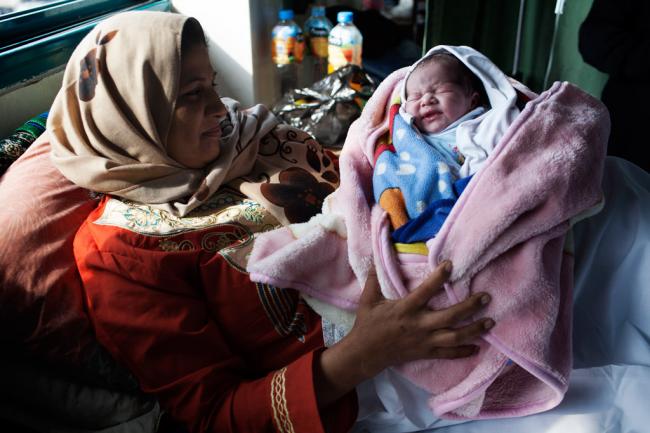
Photo: UNICEF/Loulou d’Aki
Support Our Journalism
We cannot do without you.. your contribution supports unbiased journalism
IBNS is not driven by any ism- not wokeism, not racism, not skewed secularism, not hyper right-wing or left liberal ideals, nor by any hardline religious beliefs or hyper nationalism. We want to serve you good old objective news, as they are. We do not judge or preach. We let people decide for themselves. We only try to present factual and well-sourced news.
Support objective journalism for a small contribution.