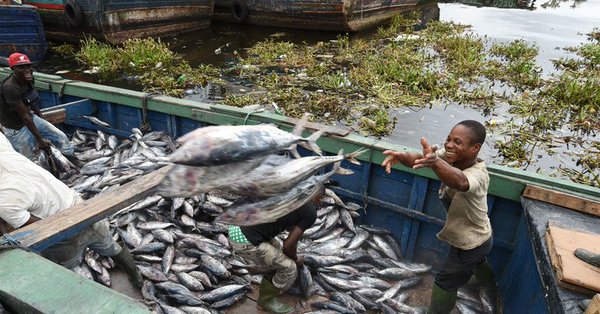
New UN agriculture agency report underscores value of fishing in fight against global hunger
New York, July 10 (IBNS): The vital role that fishing and fish-farming play in supporting some of the poorest families across the world, came under the spotlight on Monday with the publication of the annual United Nations Food and Agriculture Organization (FAO) report on the global industry.
According to the latest State of World Fisheries and Aquaculture (SOFIA) report, nearly 60 million people worldwide – 14 per cent of them women – are directly employed in fisheries and the aquaculture sector.
"The fisheries sector is crucial in meeting FAO's goal of a world without hunger and malnutrition, and its contribution to economic growth and the fight against poverty, is growing," said José Graziano da Silva, FAO’s Director-General.
Fish account for about 17 per cent of animal protein consumed around the world, providing around 3.2 billion people on earth with nearly 20 per cent of their animal protein needs.
Moreover, fish represent a highly nutritious food that is especially helpful in counteracting important deficiencies in dietary intake.
The report indicates that global fish production will continue to grow over the next ten years even though the amount of fish being captured in the wild has levelled off and aquaculture is slowing down.
Global trends can mask the large contribution fish often make as part of the basic diet in poorer countries, however. For example, in countries such as Bangladesh, Cambodia, Gambia, Sri Lanka and some small island development states, fish make up fifty per cent or more, of people's protein intake.By 2030, it’s estimated that fish production will grow to 201 million tonnes; an 18 per cent increase over the current production level of 171 million tonnes.
"The sector is not without its challenges, however, including the need to reduce the percentage of fish stocks fished beyond biological sustainability," da Silva continued.
In 2016, 90.9 million tonnes of fish were captured in the wild – a slight decrease of two million from 2015 - and aquaculture production (which entails farming aquatic organisms as well as managing ocean habitats and wild populations), reached 80 million tonnes, providing 53 per cent of all fish consumed by humans as food.
According to this latest FAO report, the amount of crustaceans, mollusks and other aquatic animals being consumed, is just over double the amount per person, back in the 1960s. FAO attributes this to increased aquaculture production, a sector that expanded rapidly during the 1980s and 1990s.
"Since 1961 the annual global growth in fish consumption has been twice as high as population growth,” said Mr. da Silva, highlighting again the importance of this to combating world hunger.
But FAO said that future growth across the industry will require continued progress in strengthening fisheries management regimes, reducing loss and waste, and tackling problems like illegal fishing, pollution of aquatic environments, and climate change, the report added.
Efforts to reduce the amount of fish being discarded at sea or thrown out post-capture – for example by using discards and trimmings to produce fishmeal – will also help meet ongoing increases in demand for fish products, said FAO.
FAO/Sia Kambou
Support Our Journalism
We cannot do without you.. your contribution supports unbiased journalism
IBNS is not driven by any ism- not wokeism, not racism, not skewed secularism, not hyper right-wing or left liberal ideals, nor by any hardline religious beliefs or hyper nationalism. We want to serve you good old objective news, as they are. We do not judge or preach. We let people decide for themselves. We only try to present factual and well-sourced news.
Support objective journalism for a small contribution.