New UN exhibit highlights need to fill in ‘blank spaces’ for child-related data
“[The 2030 Agenda for Sustainable Development] pledged to leave no one behind. That means focusing on the most vulnerable – those who are furthest behind,” Ban said at the Back To Present: Launch of a Time Machine event on Wednesday at UN Headquarters in New York.
“Meeting that goal requires data. Reliable, timely data,” he underscored.
The UN chief said that progress needs to be monitored and information on it made available in an accessible and usable form as widely as possible, and for doing so, significant investments needed to made in systems for the collection, analysis and reporting of data at national, regional and global levels.
Drawing particular attention to “blank spaces” – lack of availability of complete data – in the statistics of many countries, the Secretary-General said that this unavailability not only impacted the quality of decisions but also the ability to hold policy makers to account.
“Quality numbers alone will not change people’s lives,” he said, “but being counted makes everyone visible, and this act of recognition makes it possible to address their needs and advance their rights.”
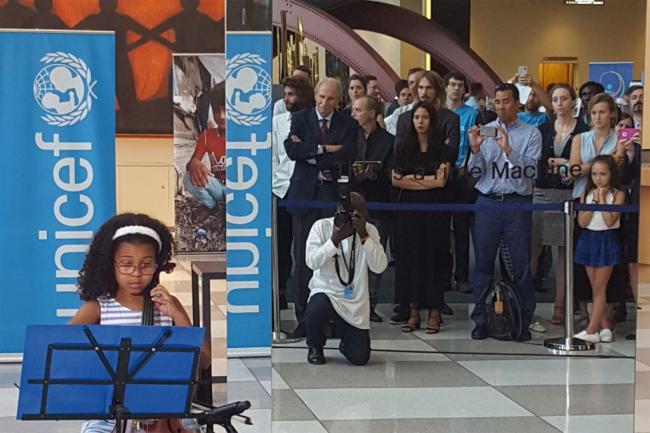
The Time Machine – produced by UNICEF in partnership with Domestic Data Streamers, a Barcelona-based agency that explores new ways of communicating through data storytelling – is a capsule-like structure that demonstrates data through art by translating childhood memories based on data into sound, giving visitors an opportunity to understand what data on children is currently available and what data is not.
Emphasizing the importance of quality data for achieving the SDGs, UNICEF called on governments to invest in disaggregated, comparable and quality data for children.
“If we are going to succeed in achieving these ambitious goals, we first need data that tells us who these children are, where they live and what they need,” Director of UNICEF’s Division of Data, Research and Policy, Jeffrey O’Malley, said in a news release on Wednesday.
Furthermore, in the release, the agency added that as per its analysis, child-related data, including measures on poverty and violence that can be compared, are either too limited or of poor quality.
Citing specific examples of missing data, it said there is lack of data on the number of children with disabilities in almost all countries and that almost no data is unavailable on boys who are at risk of sexual violence.
Governments are therefore, left without the information they need to accurately address challenges facing millions of children, or to track progress towards achieving the SDGs, added UNICEF.
The UN agency urged them to therefore invest in disaggregated, comparable and quality data for children to address this complex problem.
The Time Machine exhibition will be open to the public at the Visitors Lobby at UN Headquarters from 14 to 30 September during the annual high-level segment of the General Assembly.
Here are some examples of the data gaps:
Universal access to safe drinking water is a fundamental need and human right. Data on where drinking water comes from is available, but often it is not known how safe it is.
Nine out of 10 children are in primary school, yet crucial data about how many are learning is missing.
Every day 830 mothers die as a result of complications related to childbirth. Most of these deaths are preventable, but data on quality of maternal care has gaps.
Stunting denies children a fair chance of survival, growth and development. However, 105 out of 197 countries do have recent data on stunting.
Photo: UNICEF
Source: www.justearthnews.com
Support Our Journalism
We cannot do without you.. your contribution supports unbiased journalism
IBNS is not driven by any ism- not wokeism, not racism, not skewed secularism, not hyper right-wing or left liberal ideals, nor by any hardline religious beliefs or hyper nationalism. We want to serve you good old objective news, as they are. We do not judge or preach. We let people decide for themselves. We only try to present factual and well-sourced news.
Support objective journalism for a small contribution.