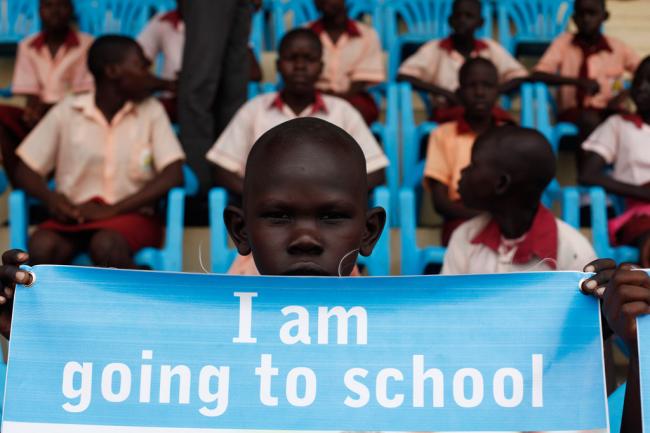
South Sudan: UN campaign for children forced out of school by war
“Around 70 per cent of the 1,200 schools in the major conflict states have closed, raising grave fears that a generation of children could be left behind by the ongoing civil war,” said Jonathan Veitch, UNICEF’s Representative in South Sudan.
He added, “Quality education is the single most important element for a country to develop economically, socially and culturally. It is also a critical human right.”
The $42 million campaign aims to allay disruption caused by the war, which has compounded the effects of an education system that was already weak at best. Before the war, primary education reached just 42 per cent of school-aged children, with only 10 per cent completing school.
UNICEF and partners will provide a comprehensive package of education support for children aged three to 18 years of age who are sheltering in camps for internally displaced people or in host communities devastated by the war, where no education services are available.
The UN agency will work with 20 local and international non-governmental organisations and aims to reach 200,000 children in schools and learning spaces in the conflict areas with pre-school and basic education, catch-up programmes for adolescents and psychosocial support in the classrooms.
An additional 200,000 children will be enrolled in 1,000 schools in non-conflict areas. Training will be provided for 4,000 teachers and early childhood development facilitators, as well as 1,500 Parent Teacher Association members.
“We have invested heavily in supplies and learning but we need an additional $12 million urgently just to provide basic education kits to target schools,” said Veitch.
He added, “This initiative will invest $100 in every child’s learning. It’s a small cost for the hope and opportunity it brings.”
The security situation in South Sudan deteriorated steadily over the past year since political in-fighting between President Kiir and his former Vice-President, Riek Machar, started in mid-December 2013.
The hostilities subsequently turned into a full-fledged conflict that has sent nearly 100,000 civilians fleeing to bases around the country operated by the UN Mission, known as UNMISS. The crisis has uprooted an estimated 1.9 million people and placed more than 7 million at risk of hunger and disease.
Photo: UNICEF/Andreea Campeanu
Support Our Journalism
We cannot do without you.. your contribution supports unbiased journalism
IBNS is not driven by any ism- not wokeism, not racism, not skewed secularism, not hyper right-wing or left liberal ideals, nor by any hardline religious beliefs or hyper nationalism. We want to serve you good old objective news, as they are. We do not judge or preach. We let people decide for themselves. We only try to present factual and well-sourced news.
Support objective journalism for a small contribution.