Sweden, Bolivia, Ethiopia and Kazakhstan elected to Security Council
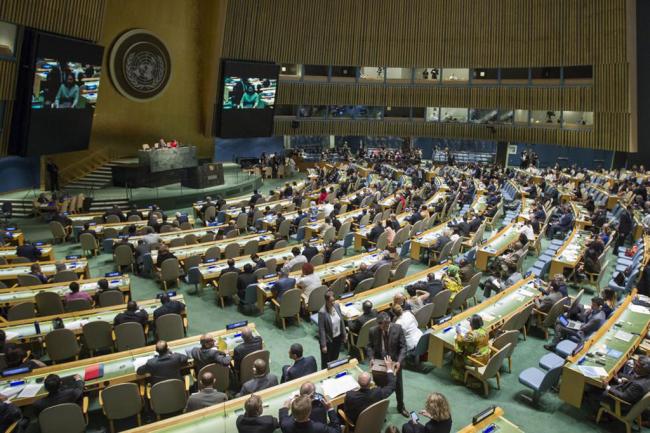
After rounds of voting at UN Headquarters in New York on Tuesday, only one non-permanent Council seat remains to be filled. Italy and the Netherlands had been vying for the remaining seat, but the voting yielded no clear winner. The two countries then suggested sharing the two-year term, each with a one-year period, with a decision on this proposal postponed to Wednesday.
Under the UN Charter, the Security Council has the primary responsibility for international peace and security, with all UN Member States required to comply with Council decisions. The Council’s 10 non-permanent seats are allocated according to a rotation pattern set by the Assembly in 1963, to ensure a proportionate representation over time from the different parts of the world: five from African and Asian States; one from Eastern European States; two from Latin American States; and two from Western European and Other States.
At on Tuesday’s election, the General Assembly members voted by secret ballot for five seats divided by geographical grouping – three from Africa and the Asia-Pacific region, one from Eastern Europe, and one from Latin America and the Caribbean.
Bolivia and Ethiopia were chosen by their regional groups and had no competitors. Kazakhstan won the seat reserved for Asia Pacific against Thailand, while Italy, the Netherlands and Sweden had competed for two seats for Western Europe.
The newly-elected countries will replace Spain, Malaysia, New Zealand, Angola and Venezuela.
The Security Council has 15 members, including five permanent. The five permanent members, each with the power of veto, are China, France, Russia, the United Kingdom and the United States. Other current non-permanent members are Japan, Egypt, Senegal, Ukraine and Uruguay.
The Security Council is also responsible for determining the existence of a threat against peace and to respond to an act of aggression. It is also responsible for finding peaceful means to settle a conflict or a dispute between States. In some cases, the Council can resort to sanctions or even authorize the use of force to maintain or restore international peace and security.
The Security Council also recommends to the General Assembly the appointment of the Secretary General and the admission of new Members to the United Nations.
UN Photo/Manuel Elias
Source: www.justearthnews.com
Support Our Journalism
We cannot do without you.. your contribution supports unbiased journalism
IBNS is not driven by any ism- not wokeism, not racism, not skewed secularism, not hyper right-wing or left liberal ideals, nor by any hardline religious beliefs or hyper nationalism. We want to serve you good old objective news, as they are. We do not judge or preach. We let people decide for themselves. We only try to present factual and well-sourced news.
Support objective journalism for a small contribution.