October 05, 2026 04:18 am (IST)

Follow us:


Syrian refugees in Lebanon cross one million mark: UN
New York, Apr 4 (IBNS): Now in its fourth year, the Syrian conflict hit yet another bleak milestone on Thursday, as the United Nations refugee agency reported that the number of displaced seeking refuge in neighbouring Lebanon has passed the one million mark, putting more pressure on a host community that is already stretched to the breaking point.
The Office of the UN High Commissioner for Refugees (UNHCR) now estimates that Lebanon has become the country with the highest per capita concentration of refugees worldwide, struggling to keep pace with a crisis that shows no signs of easing. Syrian refugees in the country now equal almost a quarter of the resident population.
"The influx of a million refugees would be massive in any country. For Lebanon, a small nation beset by internal difficulties, the impact is staggering," said UNHCR chief António Guterres.
Currently registering some 2,500 new Syrian refugees in Lebanon every day, UNHCR warns that the influx has actually been accelerating: in April 2012, there were 18,000 Syrian refugees in Lebanon; by April 2013, there were 356,000; and now, in April this year, 1 million.
"The Lebanese people have shown striking generosity, but are struggling to cope. Lebanon hosts the highest concentration of refugees in recent history. We cannot let it shoulder this burden alone," said Guterres.
Since the conflict erupted and spread in the wake of popular protests in Damascus in 2011, UNHCR has estimated that there are nearly 2.5 million Syrians registered as refugees in Lebanon, Turkey, Jordan, Iraq and Egypt.
Lebanon has since experienced serious economic shocks, from a decline in trade, tourism and investment, to an increase in public expenditures. Public services are struggling to meet increased demand, with health, education, electricity, and water and sanitation particularly taxed.
The World Bank estimates that the Syrian crisis cost Lebanon USD 2.5 billion in lost economic activity last year. With wages plummeting due to the increased labour supply, many families struggle to make ends meet, and the crisis threatens to push 170,000 Lebanese into poverty by the end of this year.
Across the country, many towns and villages now have more Syrians than Lebanese and critical infrastructure – sanitation, water supplies, waste management, clinics and hospitals – is stretched to its limits, affecting both populations alike.
With 400,000 children – which make up half the refugee population in Lebanon – the Syrian school-aged youth population is now eclipsing the number of Lebanese children in public schools. These schools have opened their doors to some 100,000 refugees, yet the ability to accept more is severely limited.
UNHCR warns that while the need for emergency relief deepens, only 13 per cent of the humanitarian aid appeal for Lebanon has been funded. The government, UN and partner agencies appealed last year for USD 1.89 billion for 2014 and only USD 242 million has been received so far.
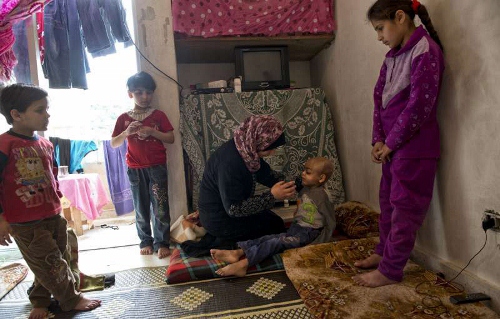
With insufficient funds, aid agencies on the ground struggle to prioritize equally urgent needs and target assistance first and foremost to the most vulnerable of a needy population. A growing number of refugees are unable to afford or to find suitable accommodation and are resorting to insecure dwellings. Some 80,000 urgently need health assistance. More than 650,000 receive monthly food aid to survive.
"International support to Government institutions and local communities is at a level that, although slowly increasing, is totally out of proportion with what is needed," Guterres deplored. "Support to Lebanon is not only a moral imperative, but it is also badly needed to stop the further erosion of peace and security in this fragile society, and indeed the whole region."
(A Syrian mother gives water to her son in Lebanon, who is desperately ill with cancer. The influx of so many refugees has severely stretched health services. Photo: UNHCR/L. Addario)
Support Our Journalism
We cannot do without you.. your contribution supports unbiased journalism
IBNS is not driven by any ism- not wokeism, not racism, not skewed secularism, not hyper right-wing or left liberal ideals, nor by any hardline religious beliefs or hyper nationalism. We want to serve you good old objective news, as they are. We do not judge or preach. We let people decide for themselves. We only try to present factual and well-sourced news.
Support objective journalism for a small contribution.


Latest Headlines
US Marine 'arrested' on Japan over suspicion of murder, PM Takaichi lodges strong protest
Sun, Oct 04 2026
flydubai co-pilot accused of hijack attempt had completed UK university course: Report
Sun, Oct 04 2026
UAE calls Flydubai cockpit attack a ‘terrorist act’; Omani pilot tried to take control
Sat, Oct 03 2026
flydubai cockpit attack: Deleted posts expose Omani co-pilot’s views on women, alleged extremist past
Sat, Oct 03 2026
flydubai cockpit horror: Omani co-pilot Hamam al-Hammami attacked Captain Smit Machchhar with crash axe, tried to seize control
Sat, Oct 03 2026