Syria's 'disastrous' conflict fuelling child labour and exploitation across region, warns new UN report
“Syria's children are paying a heavy price for the world's failure to put an end to the conflict”, says a joint press release issued on the report in Amman, Jordan.
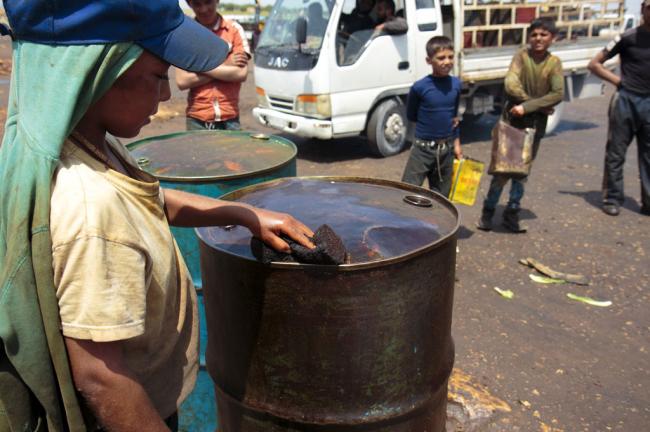
“The report shows that inside Syria, children are now contributing to the family income in more than three quarters of surveyed households, In Jordan, close to half of all Syrian refugee children are now the joint or sole family breadwinners in surveyed households, while in some parts of Lebanon, children as young as six years old are reportedly working,” the agencies said.
“The most vulnerable of all working children are those involved in armed conflict, sexual exploitation and illicit activities including organised begging and child trafficking.”
As the Syria crisis has dramatically reduced family livelihood opportunities and impoverished millions of households in the region, children are working primarily for their survival, and a spiralling number of children are employed in harmful working conditions, risking serious damage to their health and wellbeing,” according to UNICEF.
“Child labour hinders children's growth and development as they toil for long hours with little pay, often in extremely hazardous and unhealthy environments,” Dr. Peter Salama, UNICEF Regional Director for the Middle East and North Africa, said. “Carrying heavy loads, being exposed to pesticides and toxic chemicals, and working long hours – these are just some of the hazards working children face every day around the region.”
The report, Small Hands, Heavy Burden: How the Syrian Conflict is Driving More Children into the Workforce found that three out of four working children surveyed in Jordan's vast Za'atari refugee camp have reported health problems at work, and another 22 percent of children employed in the agricultural sector have also been injured while working.
“Moreover, children who work are more likely to drop out of school – adding to fears of a “lost generation” of Syrian children,” according to the report.
UNICEF and Save the Children called on partners and champions of the so-called “No Lost Generation” Initiative, the wider international community, host governments, and civil society to undertake a series of measures to address child labour inside Syria and in countries affected by the humanitarian crisis including making more funding available for income-generating activities, providing quality and safe education for all children impacted by the crisis and ending the worst forms of child labour.
UNICEF said that Syria was a middle-income country before the war in 2011. The country's economy was capable of providing a decent living for most of its people; almost all children in Syria went to school, and literacy rates were over 90 per cent.
But four and a half years into the conflict, the country is beset with destitution and misery, with four in five people in Syria estimated to be living in poverty and 7.6 million internally displaced with an estimated two million children are now living outside Syria as refugees, the agency said, and unemployment rates in Syria surged from 14.9 per cent in 2011 to 57.7 per cent.
Photo: Ahmad Baroudi/Save the Children
Support Our Journalism
We cannot do without you.. your contribution supports unbiased journalism
IBNS is not driven by any ism- not wokeism, not racism, not skewed secularism, not hyper right-wing or left liberal ideals, nor by any hardline religious beliefs or hyper nationalism. We want to serve you good old objective news, as they are. We do not judge or preach. We let people decide for themselves. We only try to present factual and well-sourced news.
Support objective journalism for a small contribution.