The world banks on sunshine, UN says in renewable energy report
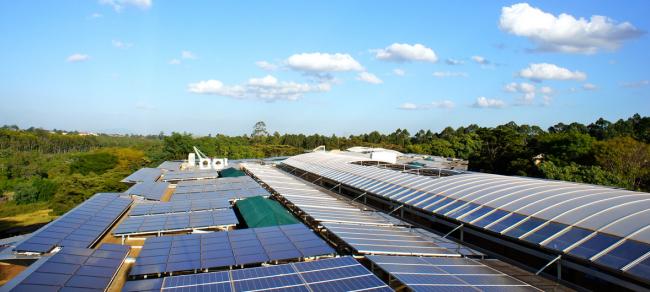
New York, Apr 6 (JEN): In 2017, solar energy dominated global investment in new power generation like never before, according to a new United Nations-backed report, which shows a steady move away from fossil fuel-based power production to ‘green’ power sources.
Last year, the world installed a record 98 gigawatts of new solar capacity, far more than the net additions of the rest – other renewables, fossil fuel and nuclear, according to the Global Trends in Renewable Energy Investment 2018 report, released Thursday by the UN Environment Programme (UNEP) and its partners.
Solar power also attracted far more investment than any other technology, at $160.8 billion, up 18 per cent.
A driving power behind last year’s surge in solar was China, where an unprecedented boom saw some 53 gigawatts added – more than half the global total – and $86.5 billion invested, up 58 per cent.
“Investments in renewables bring more people into the economy, they deliver more jobs, better quality jobs and better paid jobs. Clean energy also means less pollution, which means healthier, happier development,” he said.“The extraordinary surge in solar investment shows how the global energy map is changing and, more importantly, what the economic benefits are of such a shift,” said UNEP chief Erik Solheim.
Last year was the eighth in a row in which global investment in renewables exceeded $200 billion – and since 2004, the world has invested $2.9 trillion in these green energy sources.
Overall, China was by far the world’s largest investing country in renewables, at a record $126.6 billion, up 31 per cent on 2016. There were also sharp increases in investment in Australia, up 147 per cent to $8.5 billion; Mexico, up 810 per cent to $6 billion; and Sweden, up 127 per cent to $3.7 billion.
UN Asia-Pacific forum adopts declaration to accelerate transition to sustainable energy
Meanwhile, countries in the Asia-Pacific region, which is projected to account for two-thirds of global energy use between now and 2040, committed to accelerate the transition to sustainable energy by scaling up their share of renewables, as a United Nations forum in Bangkok wrapped up on Thursday.
“There is a palpable sense of the enormous opportunities ahead that can transform the energy scene,” Shamshad Akhtar, the Executive Secretary of the UN Economic and Social Commission for Asia and the Pacific (ESCAP), told the two-day forum, acknowledging the growing recognition by governments, the private sector and investors, that a sustainable, low carbon energy system is the only option to safeguard the future.
The highlight of the Second Asian and Pacific Energy Forum was the adoption of a ministerial declaration, which lays out a series of actions to encourage the sustainable use of energy, including through greater regional cooperation to facilitate cross-border infrastructure and energy trade to advance the 2030 Agenda for Sustainable Development.
Organized by ESCAP, the Forum provided a platform for governments, the UN system, private companies, international organizations, and civil society organizations to review the region’s implementation of Sustainable Development Goal 7 (SDG7) on affordable and clean energy.
Delegates concluded that Asia and the Pacific has made remarkable progress on universal access to electricity, with renewable energy surpassing price benchmarks that were only expected in 2020. However, greater efforts are needed throughout the region to achieve targets on reliance on clean fuel and renewable energy, and energy efficiency.
PresseBox.de flickr
Support Our Journalism
We cannot do without you.. your contribution supports unbiased journalism
IBNS is not driven by any ism- not wokeism, not racism, not skewed secularism, not hyper right-wing or left liberal ideals, nor by any hardline religious beliefs or hyper nationalism. We want to serve you good old objective news, as they are. We do not judge or preach. We let people decide for themselves. We only try to present factual and well-sourced news.
Support objective journalism for a small contribution.