 Op. Sindoor
Trump feels cheated as he did not get credit for India-Pak truce: US expert amid tariff war
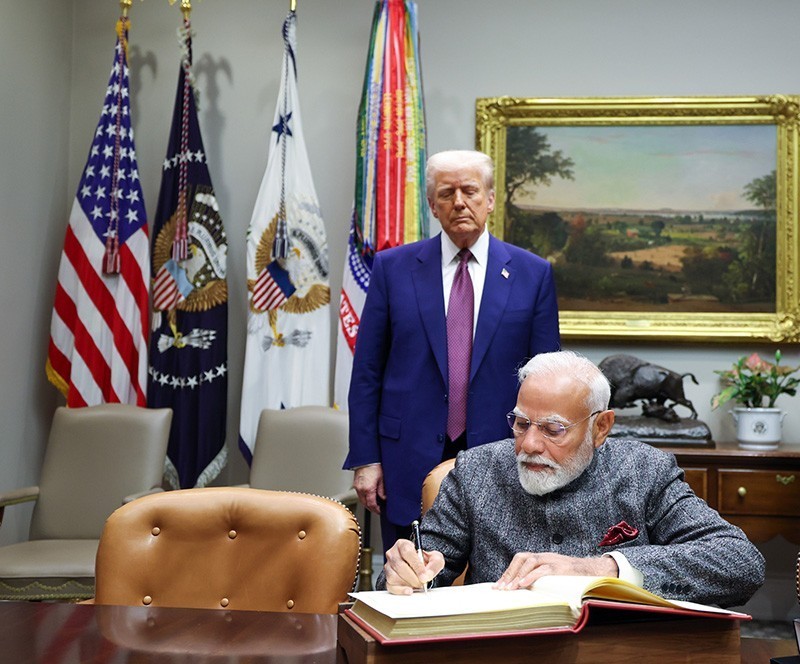
Washington DC/IBNS: US Strategic Affairs Expert Ashley J. Tellis has claimed President Donald Trump felt "cheated" for being denied the credit for the resolution of the India-Pakistan military conflict that went for about four days in May this year.
Tellis hinted at a "deeper grievance" amid the US-India conflict over unfair trade practices and Russian oil purchase.
"I think he feels cheated that he did not get the credit that he believes is his due for having resolved the India-Pakistan crisis in May 2025, and my suspicion is Prime Minister Modi's call to him, to set the record right only inflamed the situation rather than resolving it," Tellis told NDTV.
Though Trump repeatedly claimed he brokered the New Delhi-Islamabad military conflict, India's Prime Minister Narendra Modi categorically rejected it saying no global leader asked to stop Operation Sindoor, which was launched by the country's Armed Forces to avenge the April 22 Pahalgam terror attack.
Modi referred to a call from US Vice President JD Vance who had communicated to him that Pakistan was "planning to launch a major offensive" to which the Prime Minister, as he claimed, warned Islamabad to "face dire consequences" via the US Veep.
"No global leader urged India to halt the operation. On the night of the May 9, the Vice President of the United States attempted to contact me. He tried for an hour, but I was in a meeting with the military and was unable to answer.
"Later, I returned his call. During our conversation, the Vice President informed me that Pakistan was planning to launch a major offensive. In response, I firmly stated, "If this is Pakistan's intent, they will face dire consequences," Modi said.
India's policy, which was well-considered and thoroughly discussed with our military, was that our targets are terrorists, their masterminds, and their hideouts.
— BJP (@BJP4India) July 29, 2025
We clearly stated from the beginning that our actions were non-escalatory, which is why we agreed to a ceasefire.… pic.twitter.com/xby8kYKMDQ
The Indian Armed Forces launched Operation Sindoor hitting nine terrorist bases in Pakistan-occupied Kashmir (PoK).
The military conflict escalated after Pakistan targeted civilians across the borders without any provocation to be aptly countered by the Indian military.
Nine terrorist camps in Pakistan and Pakistan-occupied Kashmir (PoK) were targeted and destroyed in 25 minutes of Operation Sindoor.
The terrorists camps were the major training hubs of Pak-based terror groups- Lashkar-e-Taiba (LeT), Jaish-e-Mohammed (JeM) and Hizbul Mujahideen.
US-India tariff war
The Trump administration, which was earlier viewed as India-friendly, has slapped a 25 percent tariff on the South Asian country for its high tariffs on American exports and another 25 percent for purchasing oil from Russia which is fighting a war against Ukraine.
The White House, which has singled out India over Russian oil purchase, said the second 25 percent tariff will be effective from August 27, 2025.
Since the conflict in Ukraine began in early 2022, India significantly increased its imports of discounted Russian crude oil—now comprising over 30 percent of its total crude imports.
Indian refineries then export refined petroleum products globally which critics, especially in the U.S., argue that indirectly supports Russia’s war effort by funneling money into its economy.
In response, the US proposed tariffs and trade measures targeting India’s exports to discourage this behavior.
Support Our Journalism
We cannot do without you.. your contribution supports unbiased journalism
IBNS is not driven by any ism- not wokeism, not racism, not skewed secularism, not hyper right-wing or left liberal ideals, nor by any hardline religious beliefs or hyper nationalism. We want to serve you good old objective news, as they are. We do not judge or preach. We let people decide for themselves. We only try to present factual and well-sourced news.
Support objective journalism for a small contribution.