Turning national pledges into action crucial in fight against hunger, stresses head of UN agency
“Hunger will only be defeated if countries translate their pledges into action, especially at national and local levels,” FAO Director-General José Graziano da Silva said at the opening of the agency’s biennial conference in Rome.
Concerted effort is required in countries affected by conflict and climate change – which collectively house nearly 60 per cent of the world’s population suffering from hunger – he underscored.
“Peace is of course the key to ending these crises, but we cannot wait for peace to take action […] it is extremely important to ensure that these people have the conditions to continue producing their own food.”
FAO has currently identified 19 countries in a “protracted crisis” situation, often facing extreme climatic events, such as droughts and floods. It has also signalled the high risk of famine in north-east Nigeria, Somalia, South Sudan and Yemen with 20 million people severely affected.
These extreme conditions not only disrupt the lives of those affected, they also force many to migrate in search of better lives, compounding the distress. The most vulnerable – especially women – are often the worst impacted.
To save lives, we have to save their livelihoodsJosé Graziano da Silva, FAO chief
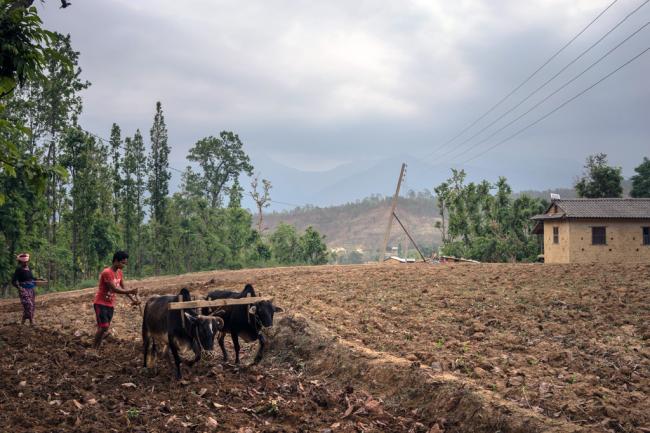
In order to alleviate the suffering of millions, the UN agency will, over the next two years, be focusing its efforts on the promotion of sustainable agriculture, climate change mitigation and adaptation, poverty reduction, water scarcity, migration as well as supporting conflict-affected rural livelihoods.
“To save lives, we have to save their livelihoods,” stressed Graziano da Silva.
Transforming agriculture sector critical for 2030 Agenda for Sustainable Development – UNDP chief
Also on Monday, delivering the McDougall Memorial Lecture, Achim Steiner, the Administrator of the UN Development Programme (UNDP), highlighted that transforming agriculture was crucial to transform the world, as envisioned in the 2030 Agenda for Sustainable Development.
This, he said, is in many ways a “profound political reforms agenda.”
“Doing so cannot be seen as a technical challenge to be addressed within the agricultural sector, but rather as a complex undertaking that calls for integrated approaches considering economic, environmental, and social aspects,” said Steiner.
“[This] needs to recognize farmers as agents of change, operating within a larger ‘agriculture economy,’ that with the right incentives and enablers, can leverage agriculture to enhance livelihoods and sustainability.”
The lecture honours Frank Lidgett McDougall, an Australian economist, who played a key role in the creation of FAO.
The FAO Conference, being held from 3 to 8 July, is the UN agency’s highest governing body. It reviews and decides on FAO’s programme of work and budget, and discusses priority areas related to food and agriculture across the globe.
Photo: ©IFAD/Sanjit Das/Panos
Source: www.justearthnews.com
Support Our Journalism
We cannot do without you.. your contribution supports unbiased journalism
IBNS is not driven by any ism- not wokeism, not racism, not skewed secularism, not hyper right-wing or left liberal ideals, nor by any hardline religious beliefs or hyper nationalism. We want to serve you good old objective news, as they are. We do not judge or preach. We let people decide for themselves. We only try to present factual and well-sourced news.
Support objective journalism for a small contribution.