 Security Council
UN elects five new members to serve on the Security Council
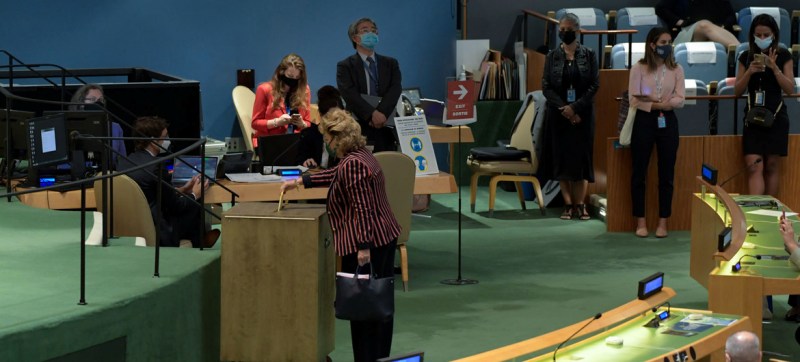
New York: Albania, Brazil, Gabon, Ghana and the United Arab Emirates (UAE) were elected by the 75th session of the General Assembly on Friday to serve as non-permanent members of the UN Security Council for the 2022-2023 term.
According to the final tally, Ghana received 185 votes, Gabon 183, UAE 179, Albania 175 and Brazil 181 votes.
The Democratic Republic of the Congo (DRC) garnered three votes while Peru and Iran each collected one.
Joining the others
The Security Council is a body of 15 members, five of which are permanent and have veto power: the United States, United Kingdom, France, Russia and China.
The newly elected five will join India, Ireland, Kenya, Mexico and Norway, the other non-permanent members.
Prior to its successful bid, the UAE issued a statement promising to be “a constructive partner” in addressing some of the “critical challenges of our time”, including promoting gender equality, countering terrorism and extremism and “harnessing the potential of innovation for peace”.
Breaking it down
Vacating their seats were Viet Nam, for the Group of Asia and the Pacific Small Island Developing States known as the Asia-Pacific Group; Saint Vincent and the Grenadines, for the Latin American and Caribbean Group, called GRULAC; Estonia, for the Eastern European Group; and Niger and Tunisia as part of the African Group.
The candidates ran mostly unopposed within their regions, except for Gabon and Ghana, which were challenged by the DRC for the two available seats in the African Group.
The five new members elected this year will begin their terms on 1 January 2022 and serve until 31 December 2023.
While Albania is the only State that has never served previously, Brazil has sat on the Council ten times, Gabon and Ghana three times each and UAE once.
Path to service
Before applying, each country must obtain the votes of two-thirds of the Member States present and voting at the General Assembly, to secure a seat on the Council.
Broken down, this translates to a minimum of 129 votes, to win a seat if all 193 UN Member States are present and voting.
Even if candidates have been endorsed by their regional group and are running unopposed, formal balloting is required.
Though unlikely, in the first round a Member State running unchallenged might not garner the requisite votes in the Assembly and face a new challenger in subsequent rounds.
There have, historically, been several instances in which extended rounds of voting were required to fill a contested seat.
Such situations have usually been resolved when one of the contenders withdraws, or a compromise candidate is elected.
Exceptionally, countries competing for a seat have decided to split the term between them. But since 1966, this only happened once, in 2016, when Italy and the Netherlands agreed to split the 2017-2018 term.
Since 2010, 78 per cent of races for Security Council seats have been uncontested.
Support Our Journalism
We cannot do without you.. your contribution supports unbiased journalism
IBNS is not driven by any ism- not wokeism, not racism, not skewed secularism, not hyper right-wing or left liberal ideals, nor by any hardline religious beliefs or hyper nationalism. We want to serve you good old objective news, as they are. We do not judge or preach. We let people decide for themselves. We only try to present factual and well-sourced news.
Support objective journalism for a small contribution.