October 05, 2026 07:44 am (IST)

Follow us:


UN launches tools to tether investment to disaster risk planning
New York, May 20 (IBNS): Launching an initiative to mainstream disaster risk management into business investment, the United Nations on Monday showcased a digital globe that viscerally lays out current and possible future effects of climate change and other threats, to help stem rampant economic loss from geographic events.
The initiative, called R!SE, “provides a new formula for averting economic losses from disasters, which are a major brake on economic growth and development,” UN Deputy Secretary-General Jan Eliasson said at the launch, organized in New York by the UN Office for Disaster Risk Reduction (UNISDR).
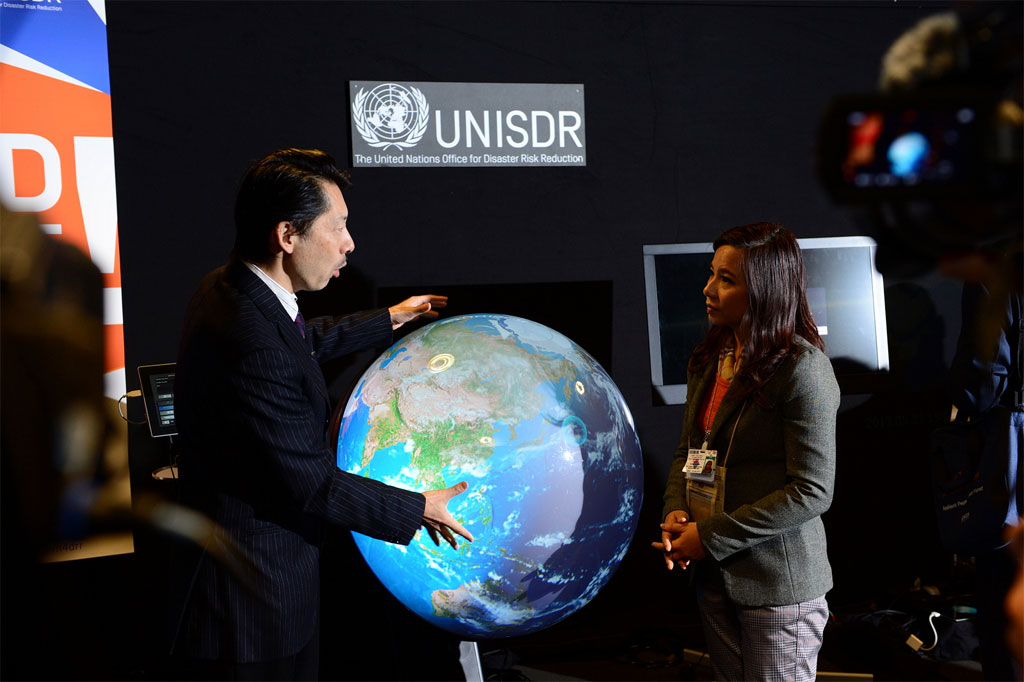
“Because R!SE brings together businesses, investors, insurers, public bodies and educators, it can be the catalyst we need to bring lasting change to how we approach risk,” Eliasson added, ahead of a demonstration of the Tangible Earth digital globe, that, among other functions, has been used to engage the private sector to play its part in reducing disaster risk.
A response to ten years of record-breaking economic losses and disruption from disasters, which Secretary-General Ban Ki-moon has called “out of control,” the R!SE partnership will develop and promote global standards on risk metrics and voluntary industry standards for disaster risk-sensitive investment, UNISDR said in a press release.
Margareta Wahlström, head of UNISDR, explained that “disaster risk is not natural but is produced by investment decisions and the range of factors that influence those decisions.” In other words, she added, “There are consequences for ignoring the principles of good land-use and building regulations in any business.”
So far, the partnership includes PricewaterhouseCoopers, The Economist Intelligence Unit, Florida International University, Principles for Responsible Investment, the design and construction firm AECOM and global insurance broker Willis, according to UNISDR.
A minimum of 1,000 asset owners and investment managers, 200 insurers and re-insurers and 100 global businesses in at least 50 cities and 20 countries are targeted for engagement by the R!SE initiative by 2020.
Demonstrating the Tangible Earth globe at the R!SE launch, its inventor Professor Shinichi Takemura showed how the globe portrays the planetary effects of climate variations, earthquake, air pollution and settlement patterns.
Built with the participation of UNISDR to a 1:15 million ratio, compared to the actual earth, the globe can show the real time reverberations of seismic events around the world, or project the population centres flooded by a few metres’ rise in sea level.
It spins at the flick of a finger on its surface, like a schoolroom globe, but is many times more powerful, zooming in on specific areas and graphically revealing innumerable trends and data-sets.
“I am very sorry that children in 21st century are still learning geography, geology and global warming using two-dimensional maps invented in 16th century,” Takemura told the UN News Centre. “We really need a global medium that will represent what is really going on our planet - that is why we created this thing.”
He added: “We are the first generation who came to understand exceptional beauty, dynamism and rareness of our planet in the context of the universe. We need to convey this message.”
(Professor Shinichi Takemura demonstrates the Tangible Earth interactive digital globe. Photo: UNISDR)
Support Our Journalism
We cannot do without you.. your contribution supports unbiased journalism
IBNS is not driven by any ism- not wokeism, not racism, not skewed secularism, not hyper right-wing or left liberal ideals, nor by any hardline religious beliefs or hyper nationalism. We want to serve you good old objective news, as they are. We do not judge or preach. We let people decide for themselves. We only try to present factual and well-sourced news.
Support objective journalism for a small contribution.



Latest Headlines
US Marine 'arrested' on Japan over suspicion of murder, PM Takaichi lodges strong protest
Sun, Oct 04 2026
flydubai co-pilot accused of hijack attempt had completed UK university course: Report
Sun, Oct 04 2026
UAE calls Flydubai cockpit attack a ‘terrorist act’; Omani pilot tried to take control
Sat, Oct 03 2026
flydubai cockpit attack: Deleted posts expose Omani co-pilot’s views on women, alleged extremist past
Sat, Oct 03 2026
flydubai cockpit horror: Omani co-pilot Hamam al-Hammami attacked Captain Smit Machchhar with crash axe, tried to seize control
Sat, Oct 03 2026