UN peacekeeping chief wraps up three-day visit to Lebanon
New York, Feb 28 (JEN): The head of United Nations Peacekeeping Operations has wrapped up a visit to Lebanon with a call on leaders from Lebanon as well as Israel to take advantage of the role UN peacekeeping can play in finding political solutions to conflict.
The Under-Secretary-General for Peacekeeping Operations, Jean-Pierre Lacroix, concluded on Tuesday the Lebanon leg of his wider Middle East tour to visit UN missions, including the UN Interim Force in Lebanon (UNIFIL), and high-ranking government officials in the region.
While in Lebanon, Lacroix met with President Michel Aoun and other senior officials, and saw first-hand the crucial work done by UNIFIL, in close coordination with the national armed forces.
UNIFIL was established in 1978 following Israel’s invasion of southern Lebanon after the Palestinian Liberation Organization (PLO) carried out a deadly attack on its territory.
Today, some 10,500 peacekeepers from 41 countries are serving in its area of operations and at sea as UNIFIL is complemented by a six-vessel Maritime Task Force: the first and only one of its kind in UN peacekeeping.
Lacroix praised the Lebanese Government’s continuous support and cooperation in implementing the UNIFIL mandate, which includes monitoring the cessation of hostilities in the wake of the July 2006 conflict.
The UN peacekeeping chief also underlined the need for the parties to work together to build on the years of relative calm since then.
“It is important for the leaders on both sides to take advantage of the window of opportunity that UNIFIL has helped provide to work towards a permanent ceasefire and long-term solution to the conflict as envisaged in UN Security Council resolution 1701,” he said. “A peacekeeping operation helps create the space for political solutions.”
Security Council resolution 1701, adopted in August 2006, called for an end to hostilities between Israel and Hezbollah in south Lebanon.
It mapped out steps for a permanent ceasefire and a long-term solution to the conflict.
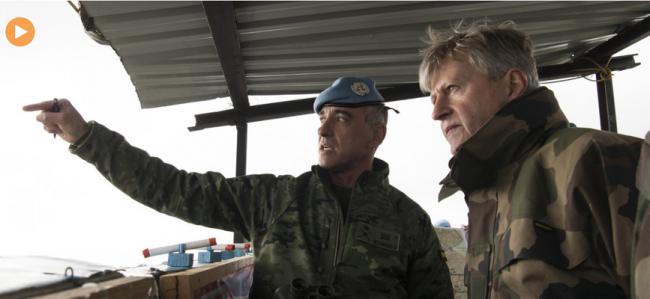
Lacroix toured the UNIFIL area of operations and the Blue Line, a border demarcation established in June 2000 to confirm the withdrawal of Israeli forces from southern Lebanon following another invasion in June 1982.
“I am impressed with the work of UNIFIL and its high tempo of patrolling both during the day and at night as well as their activities to maintain stability, especially along the Blue Line,” he said.
Lacroix expressed appreciation for the UN force’s efforts to de-escalate tensions through its participation in a forum bringing together senior Lebanese and Israeli officials which was chaired by UNIFIL Head of Mission and Force Commander, Major General Michael Beary.
Photo: Pasqual Gorriz/UN
Support Our Journalism
We cannot do without you.. your contribution supports unbiased journalism
IBNS is not driven by any ism- not wokeism, not racism, not skewed secularism, not hyper right-wing or left liberal ideals, nor by any hardline religious beliefs or hyper nationalism. We want to serve you good old objective news, as they are. We do not judge or preach. We let people decide for themselves. We only try to present factual and well-sourced news.
Support objective journalism for a small contribution.