UN policy-making body opens annual session in Vienna
“The commitment of Member States to the balanced approach is clearly evident in the broad range of draft resolutions presented at this CND,” the Executive Director of the UN Office on Drugs and Crime (UNODC) Yury Fedotov told the nearly 1,000 delegates gathered in Vienna.
Fedotov praised the Commission for its vital role as a policy-making body on narcotic drugs within the UN system as well as its support for his Vienna-based organization to achieve greater strategic and operational coherence.
Working with the Commission had enabled UNODC to “put in place integrated, inter-regional responses linking UNODC's country, regional and global programmes to confront the challenges of illicit drugs,” he said.
The hard work of confronting illicit drug supply and demand, he said, went on every day and was the result of the commission’s and UNODC’s collective efforts.
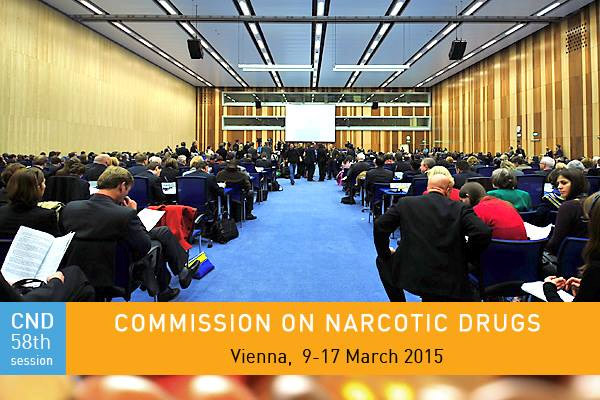
The Commission’s session, being held between 9 and 17 March in Vienna, will include a special four-day segment on preparations for the UN General Assembly special session on the world drug problem in 2016.
Following this, between 13 and 17 March, the Commission’s regular segment will include deliberations on draft resolutions and the scope of the control of substances.
This session brings together around 1,000 delegates representing Member States, inter-governmental organizations, civil society and the media for a global discussion on the world drug problem, according to UNODC.
This year, the Commission discusses 12 draft resolutions, i.e, Promoting evidence based treatment and care for young people affected by drug use disorders, alternative sentences for drug involved offenders and protecting young people and children, including from the sale of illicit drugs and new psychoactive substances online.
Also it includes promoting the role of drug analysis labs as well as scientific research, and strengthening cooperation with academia, promoting the use of the international electronic import and export authorization system for licit international trade in narcotic drugs and psychotropic substances, supporting alternative development, as well as international cooperation to respond to synthetic drugs and confronting financial flows linked to drug trafficking.
UNODC’s work, Fedotov noted, sought to “protect the health of people; including those suffering from HIV or hepatitis; ensure access to treatment services and essential medicines; promote fundamental human rights; build viable alternative livelihoods and stop criminals from exploiting the vulnerable.”
He also said that it had been 60 years since the General Assembly decided to establish the UN Narcotics Laboratory, which is the predecessor of UNODC’s Laboratory and Scientific Section.
UNODC was established in 1997 as a result of the merging of the UN’s Centre for International Crime Prevention and the UN International Drug Control Programme. It was established by the UN Secretary-General to enable the Organization to focus and enhance its capacity to address the interrelated issues of drug control, crime and international terrorism in all its forms.
Photo: UNODC
Support Our Journalism
We cannot do without you.. your contribution supports unbiased journalism
IBNS is not driven by any ism- not wokeism, not racism, not skewed secularism, not hyper right-wing or left liberal ideals, nor by any hardline religious beliefs or hyper nationalism. We want to serve you good old objective news, as they are. We do not judge or preach. We let people decide for themselves. We only try to present factual and well-sourced news.
Support objective journalism for a small contribution.