UN spotlights key role of evaluation in new development agenda
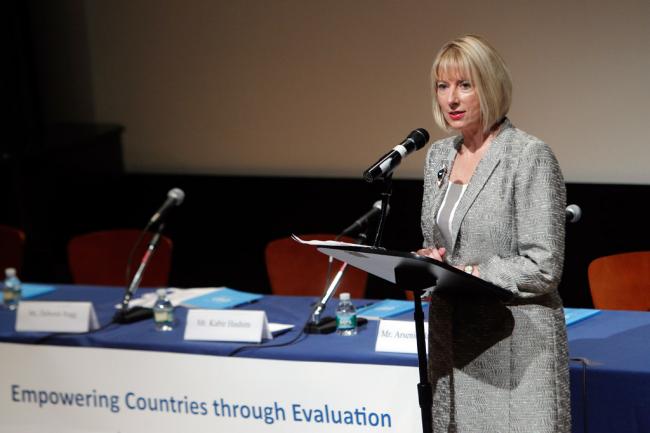
“We must review what we learned implementing the Millennium Development Goals – what worked and what didn’t work,” Deborah Rugg, Chair of the UN Evaluation Group (UNEG), said in a news release.
It also said, “As evaluators, we offer evidence to answer these questions and help determine what needs to be done differently.”
The Group’s new report, entitled ‘Evaluation Changes Lives – Realizing Evaluation’s Potential to Inform the Global Sustainable Development Goals,’ focuses on topics ranging from gender equality, improving public accountability, cutting greenhouse gas emissions and protecting civilians in conflict zones.
It states, for example, that the evaluation of peacekeeping missions’ effectiveness in protecting civilians highlighted weak links in peacekeeping operations for review by the Security Council, troop-contributing countries and missions, and paved the way for a new comprehensive review with far-reaching impact.
According to the UNEG publication, capacity-building for evaluation at the country level is imperative to ownership of the development agenda and improved public accountability, as witnessed by the success of the Moroccan Evaluation Association and the national monitoring and evaluation system of the Philippines.
The official launch of the publication took place during the 2015 UNEG Evaluation Week (9-13 March), which brought together UN evaluators from all over the world to discuss the inclusion of evaluation in the post-2015 development agenda through evaluation capacity building.
“Evaluation everywhere, and at every level, will play a key role in implementing the new development agenda,” Secretary-General Ban Ki-moon said at the High-level Event of the Evaluation Week.
He also said, “Evaluation is not easy. Nor is it popular. But it is essential. All of us share a responsibility to strengthen this important function.”
On 19 December 2014, the General Assembly adopted the first resolution on evaluation and also designated the year 2015 as the International Year of Evaluation.
The UNEG is an inter-agency professional network that brings together the evaluation units of the UN system, including UN departments, specialized agencies, funds and programmes, and affiliated organizations.
It currently has 45 members and three observers. UNEG’s mission is to promote the credibility and usefulness of the evaluation function across the UN system.
Photo: UN Photo/Devra Berkowitz (file)
Support Our Journalism
We cannot do without you.. your contribution supports unbiased journalism
IBNS is not driven by any ism- not wokeism, not racism, not skewed secularism, not hyper right-wing or left liberal ideals, nor by any hardline religious beliefs or hyper nationalism. We want to serve you good old objective news, as they are. We do not judge or preach. We let people decide for themselves. We only try to present factual and well-sourced news.
Support objective journalism for a small contribution.