October 05, 2026 08:40 am (IST)

Follow us:


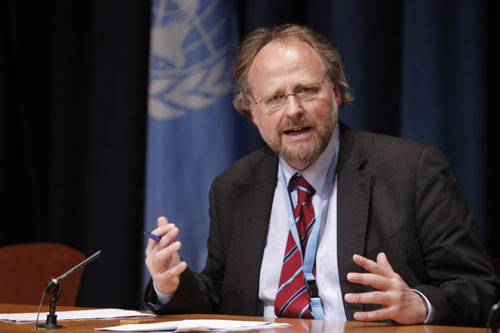
UN urges Kazakhstan to end registration of religious communities
New York, Apr 5 (IBNS): The United Nations expert on religious freedom called on Friday on the Kazakhstan Government to halt the mandatory registration of religious communities, which notably affects small groups.
During a visit to Kazakhstan – mandated by the UN Human Rights Council – Heiner Bielefeldt, Special Rapporteur on freedom of religion or belief found religious pluralism to be a hallmark of the society “traceable far back in history and perhaps even pre-history.”
“Some of the people I talked to during my visit invoked specifically nomadic traditions of hospitality and open-mindedness when explaining the accommodation of different religious communities in Kazakhstan on Friday,” Bielefeldt said.
However, a 2011 Law on Religious Associations requires all religious communities in Kazakhstan to obtain registration status to exercise collective religious functions.
Bielefeldt pointed out that, registering religious communities leads to legal insecurity.
“Those communities, which fail to meet the threshold set by the law or prefer not to be registered, live in legal insecurity which adversely affects their freedom of religion or belief,” he warned.
While Bielefeldt acknowledged the active role Kazakh authorities play in promoting peaceful interreligious coexistence, he added “freedom of religion or belief inherently belongs to all human beings and does not require State’s approval.”
Noting the country’s secular constitution received general approval by the population, he said that during his visit, he sometimes came across restrictive interpretations that confined freedom of religion or belief to pre-defined territorial spaces.
The Special Rapporteur recommended, “an open discussion of the meaning and implications of secularism” to help “overcome restrictive attitudes within the administration and within law-enforcement agencies.”
Bielefeldt spent 12 days in Astana, Almaty and Karaganda meeting with Government officials and agencies; religious and belief communities; and civil society organizations.
In 2015, the Special Rapporteur will present a report containing his conclusions and recommendations to the UN Human Rights Council.
Independent experts or special rapporteurs are appointed by the UN Human Rights Council to examine and report back on a country situation or a specific human rights theme. The positions are honorary and the experts are not UN staff, nor are they paid for their work.
(Special Rapporteur on freedom of religion or belief Heiner Bielefeldt. UN Photo/Paulo Filgueiras)
Support Our Journalism
We cannot do without you.. your contribution supports unbiased journalism
IBNS is not driven by any ism- not wokeism, not racism, not skewed secularism, not hyper right-wing or left liberal ideals, nor by any hardline religious beliefs or hyper nationalism. We want to serve you good old objective news, as they are. We do not judge or preach. We let people decide for themselves. We only try to present factual and well-sourced news.
Support objective journalism for a small contribution.
Latest Headlines
US Marine 'arrested' on Japan over suspicion of murder, PM Takaichi lodges strong protest
Sun, Oct 04 2026
flydubai co-pilot accused of hijack attempt had completed UK university course: Report
Sun, Oct 04 2026
UAE calls Flydubai cockpit attack a ‘terrorist act’; Omani pilot tried to take control
Sat, Oct 03 2026
flydubai cockpit attack: Deleted posts expose Omani co-pilot’s views on women, alleged extremist past
Sat, Oct 03 2026
flydubai cockpit horror: Omani co-pilot Hamam al-Hammami attacked Captain Smit Machchhar with crash axe, tried to seize control
Sat, Oct 03 2026