October 06, 2026 07:56 am (IST)

Follow us:


UN urges respect for Guinea-Bissau vote results
New York, Apr 12 (IBNS): With preparations supported by the United Nations, voters in Guinea-Bissau head to the polls this Sunday in presidential and parliamentary elections many hope will bring stability to the tiny West African nation.
Postponed several times, the elections will be the first to take place since the 2012 military coup which ousted interim President Raimundo Pereira. They are widely seen as essential to restoring constitutional order, economic growth and development.
On the eve of the polls, Secretary-General Ban Ki-moon called on the people and institutions of Guinea-Bissau to ensure the conduct of peaceful and credible elections, adding that the candidates and their supporters, the Transitional Government, election management bodies, civil society and the population at large all have an important role to play in this regard.
Gana Fofang, Deputy Special Representative of the Secretary-General and UN Resident Coordinator in Guinea-Bissau, called on all citizens to not only go out and vote in peace, but to commit to accepting the results. “What Guinea-Bissau needs is a return to constitutional normalcy. Only then will the country be able to get back on a more robust development pathway.”
The UN Development Programme (UNDP) has been supporting the election cycle in Guinea-Bissau, managing a USD 6.6 million basket fund that includes financing from the European Union, South Africa, Japan, the UN Peacebuilding Fund, the United Kingdom, Nigeria, Turkey, and Brazil.
The funds have been used to help the National Election Commission (NEC) organize the ballot, buy voting materials, organize civic education activities and train election officials. For the first time, the Commission now has its own, fully refurbished building in the capital, Bissau.
In parallel, UNDP delivered voting materials, including 800,000 ballot papers and 6,000 ballot boxes, plus 6,000 voting booths and bottles of indelible ink.
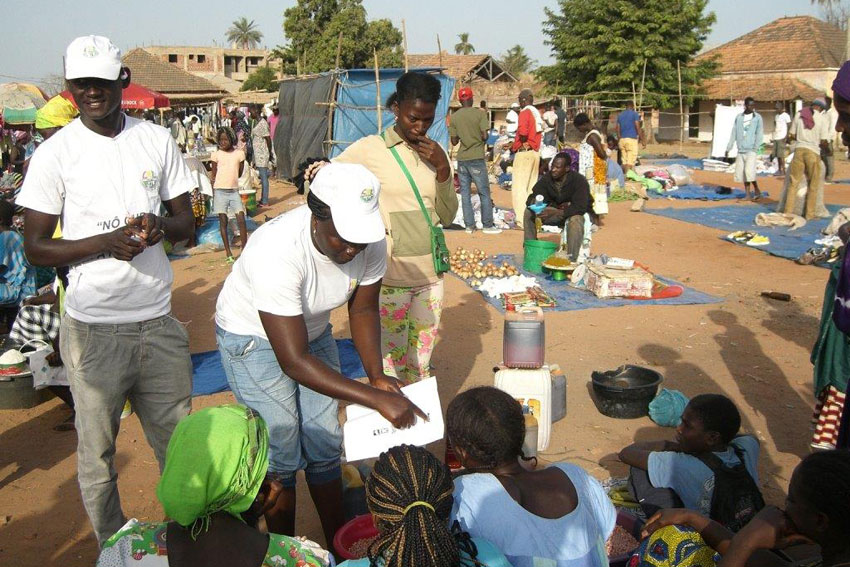
A vast civic education campaign took place, with door-to-door visits to communities and voter outreach activities in public places. Some of these activities even took place in schools, where children for the first time learned about what it means to vote.
“This is the first time I am going to vote. My aim is to choose a Government that can solve the problems of the country and provide education for youth. With the elections, all these things might happen,” says Diamantino Barai, an 18-year-old student residing in Bissau, who will be voting for the first time.
Like many women and men in Guinea-Bissau, Barai is anxious about the future. More than two-thirds of the population is living on less than USD 2 a day and the country’s development indicators are among the lowest on the continent. For instance, life expectancy is only 48.6 years.
Ahead of the polls, community radios and private and public radio stations also broadcast messages of peace and educated voters on how to cast their ballots. In total, 1,000 civic education agents and 15,170 polling station officers were trained.
Financed by the Peacebuilding Fund, the Gorée Institute, a Senegal-based civil society organization, established a crisis cell with women from two national non-governmental organizations deployed in the field to monitor potential incidents. The operation was coordinated by the UN Entity for Gender Equality and the Empowerment of Women (UN Women).
(Civic education officials visit communities to explain voting procedures ahead of presidential and parliamentary elections on 12 April, 2014 Photo: UNDP Guinea Bissau)
Support Our Journalism
We cannot do without you.. your contribution supports unbiased journalism
IBNS is not driven by any ism- not wokeism, not racism, not skewed secularism, not hyper right-wing or left liberal ideals, nor by any hardline religious beliefs or hyper nationalism. We want to serve you good old objective news, as they are. We do not judge or preach. We let people decide for themselves. We only try to present factual and well-sourced news.
Support objective journalism for a small contribution.
Latest Headlines
Three Indian sailors safe after cargo ship struck and sunk off Romania in Black Sea attack; two dead
Mon, Oct 05 2026
‘Stomp on your head’: Omani flydubai co-pilot’s chilling posts on violence against women surface
Mon, Oct 05 2026
Flydubai cockpit incident: Omani pilot 'planned' to crash plane into Israel's Ben Gurion Airport in 9/11-style attack
Mon, Oct 05 2026
US Marine 'arrested' on Japan over suspicion of murder, PM Takaichi lodges strong protest
Sun, Oct 04 2026
flydubai co-pilot accused of hijack attempt had completed UK university course: Report
Sun, Oct 04 2026