October 06, 2026 06:04 am (IST)

Follow us:


UN welcomes new US Supreme Court death penalty ruling
New York, May 31 (IBNS): Citing a new ruling issued by the United States Supreme Court, the United Nations human rights office on Friday touted this latest development as a watershed moment in the country's rulings regarding the use of the death penalty against people with mental and intellectual disabilities.
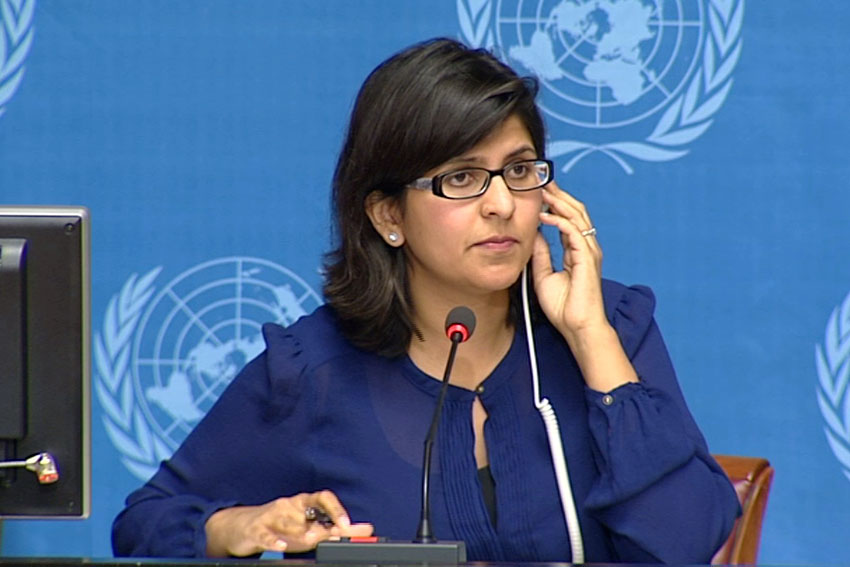
“OHCHR (The Office of the UN High Commissioner for Human Rights) welcomes the Supreme Court’s ruling as a significant step towards limiting the scope of the death penalty in the United States,” spokesperson Ravina Shamdasani told the reporters in Geneva.
According to OHCHR, the particular case involved a death row prisoner in Florida. To date, the state of Florida has refused to evaluate any evidence about a defendant’s alleged intellectual disability unless the person scored 70 or below on an IQ test. The defendant in this case had scored 71 on one IQ test.
However, stating that “intellectual disability is a condition, not a number,” the Supreme Court ruled in this case that it was unconstitutional to refuse to consider mental factors other than an IQ test.
The current ruling will affect not only Florida, the state which has the second-largest number of death penalty cases after California, but also other states that have people on death row in the US. Moreover, judges will now be required to take a less mechanical approach to mental disability in capital cases, according to OHCHR.
In 2002, the Supreme Court clarified in the Atkins vs. Virginia case that no state may execute people with mental disabilities. Further, Tuesday’s decision regarding the Florida case builds on Atkins, making it clearer now who counts as an individual with intellectual disabilities.
“The death penalty is the gravest sentence our society may impose. Persons facing that most severe sanction must have a fair opportunity to show that the Constitution prohibits their execution,” the Court states in its judgment, adding that “Florida’s law contravenes our Nation’s commitment to dignity and its duty to teach human decency as the mark of a civilized world.”
“We urge United States’ authorities to go further and to establish a moratorium on executions with a view to abolishing the death penalty,” added Shamdasani.
(Ravina Shamsadani, Spokesperson for the Office of the UN High Commissioner for Human Rights. UN Photo)
Support Our Journalism
We cannot do without you.. your contribution supports unbiased journalism
IBNS is not driven by any ism- not wokeism, not racism, not skewed secularism, not hyper right-wing or left liberal ideals, nor by any hardline religious beliefs or hyper nationalism. We want to serve you good old objective news, as they are. We do not judge or preach. We let people decide for themselves. We only try to present factual and well-sourced news.
Support objective journalism for a small contribution.


Latest Headlines
Canada Post cuts fuel surcharge by 15% on domestic parcels through the holiday shipping push
Mon, Oct 05 2026
Canada: Monument in Victoria lists nearly 25,000 Japanese Canadians uprooted from B.C. homes in Second World War
Mon, Oct 05 2026
Carney unveils National AI Council to guide Canada's push for tech sovereignty and 250,000 new jobs
Sat, Oct 03 2026