Urgent need to step-up protection of children in crises – UN rights wing
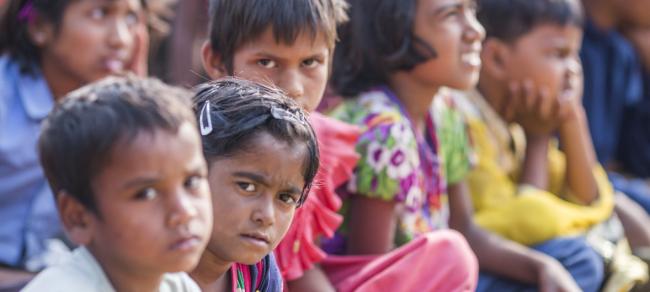
New York, Mar 6 (JEN): Children in crisis situations face a raft of challenges – from family separation and forced recruitment to sexual exploitation and abject poverty – the deputy United Nations human rights chief said Monday, urging immediate action to protect children from the consequences of “all too adult failings.”
“In 2016 alone, 43 million children across 63 countries required humanitarian assistance,” Kate Gilmore, UN Deputy High Commissioner for Human Rights, told the annual day-long meeting on the rights of the child, Protecting the Rights of the Child in Humanitarian Situations.
“And, today, 357 million children live in conflict zones – up by some 75 per cent since last century’s last decade and accounting for one in six children globally,” she added.
From floods, earthquakes and hurricanes to man-made political and economic instability, and armed conflicts between and among State and non-State parties globally, the costs of adult misconduct and the consequences their misbehaviour as political, social and economic guardians have let down millions of children.
Countless unknown children have lost their lives in terrified transit on the Mediterranean sea; thousands have been violated in Myanmar’s Rakhine state; girls have been subjected to sexual abuse and exploitation by Blue-helmeted troops; and others violated by numbers of religious and secular aid-workers.
“The tragedy of these all-too-adult failings are borne by children, but the shame is surely not children’s to bear,” she stated, pointing out that children are the vast majority of the populations most affected by conflict, most afflicted by abject poverty, most exposed to climate change.
“In flight, children face additional sexual abuse and exploitation, child labour and trafficking. In transit, they meet further abuse, neglect and deprivation of essential services,” she continued.
“At reception, they more often meet unlawful detention, xenophobia and an absence of care for the physical and mental trauma to which they have been subjected,” she maintained.
Recalling that children make up half of the world’s displaced people and more than half of its refugees, Ms. Gilmore emphasized: “No matter where they are, nor the status of their movement within or across borders – irregular as that may be – a child’s rights never abandons them.”
However, the tolerance for children’s abuse appears so high that no matter what is learned of its scale, breadth, or long-lasting damage, the world struggles to put its responsibilities to children front and centre.
Questioning why, in 2018, the Secretary-General should need to confirm the UN’s zero-tolerance policy for sexual exploitation and abuse of children and adults, Ms. Gilmore stated: “The UN must own its shame.”
“International human rights law applies at all times, in all settings for all peoples of all ages,” she underscored, noting that in the seventh decade of the Universal Declaration of Human Rights, “we must strongly affirm that human rights hold and human rights persist, even in humanitarian settings and specifically for children.”
Children’s interests be put at the forefront of decision-making processes.
“We must bring children in – bring children to sit at the tables of decision making and participation and specifically so for the design, implementation and monitoring of our humanitarian assistance activities,” she urged.
UNICEF/Vishwanathan
Support Our Journalism
We cannot do without you.. your contribution supports unbiased journalism
IBNS is not driven by any ism- not wokeism, not racism, not skewed secularism, not hyper right-wing or left liberal ideals, nor by any hardline religious beliefs or hyper nationalism. We want to serve you good old objective news, as they are. We do not judge or preach. We let people decide for themselves. We only try to present factual and well-sourced news.
Support objective journalism for a small contribution.