 Bangladesh
Who was Osman Hadi — An anti-India influencer whose killing has triggered unrest across Bangladesh
The death of Sharif Osman Hadi has emerged as a defining moment in Bangladesh’s already volatile political transition.
As confirmation of his demise spread late on Thursday, protests erupted across parts of Dhaka, underscoring the polarising influence Hadi wielded in life—and the tensions his killing has unleashed in death.
Hadi, a senior figure associated with the "radical" platform Inquilab Mancha, died in Singapore after sustaining gunshot injuries in an attack in central Dhaka earlier this month.
His killing has not only unsettled the capital but also intensified debates around radical politics, nationalism, and Bangladesh’s fraught ties with India.
From student protests to radical politics
Hadi rose to prominence during the mass student-led uprising of mid-2024 that culminated in the ouster of long-serving prime minister Sheikh Hasina.
Within that movement, he gained recognition as a confrontational organiser who favoured uncompromising action over negotiation.
Tight security deployed at Hazrat Shahjalal International Airport in Dhaka ahead of the arrival of Osman Hadi’s body, as supporters and onlookers gather in anticipation. pic.twitter.com/9rlG9T5j04
— Aditya Raj Kaul (@AdityaRajKaul) December 19, 2025
Inquilab Mancha, the group he helped shape, projected itself as a revolutionary force determined to dismantle the old political order.
While the movement drew energy from youth anger and disillusionment, critics repeatedly flagged its increasingly radical tone.
Despite its role in the uprising, the interim administration later disbanded the group, citing concerns over extremism.
‘Greater Bangladesh’ controversy
What set Hadi apart from many of his contemporaries was his overt hostility toward India.
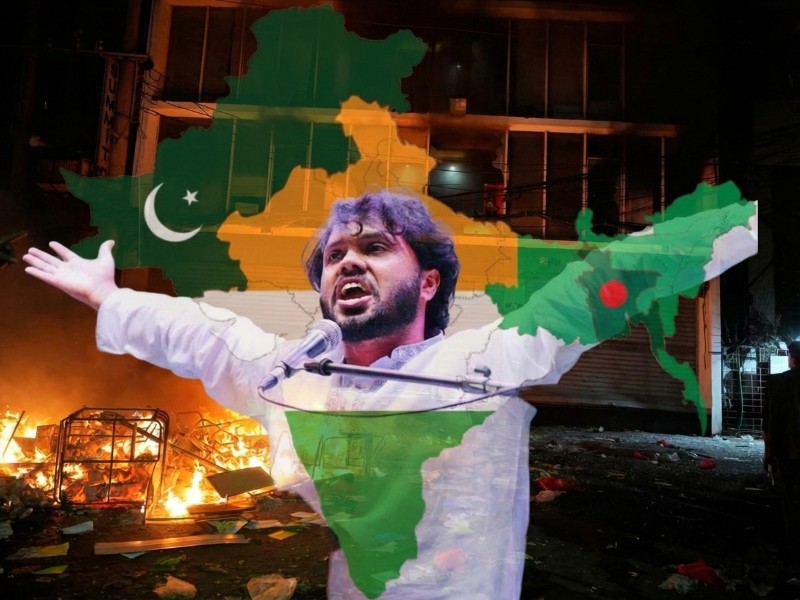
He became widely known for promoting the idea of a so-called “Greater Bangladesh,” a concept that triggered outrage in New Delhi and alarm within sections of Bangladesh’s own political class.
Maps circulated by Hadi and his supporters depicted large parts of India’s northeastern region as Bangladeshi territory.
Massive protest right now in Dhaka, Bangladesh. Nara e Takbeer Allah Hu Akbar slogans. Slogans also being chanted against India. Yunus is giving a red carpet welcome to Islamist radicals. pic.twitter.com/CBHnCVquFW
— Aditya Raj Kaul (@AdityaRajKaul) December 19, 2025
Though dismissed by mainstream parties as provocative fantasy, the imagery gained traction online and cemented Hadi’s reputation as an unapologetic anti-India ideologue.
Analysts say this narrative helped him mobilise a niche but vocal base that viewed India as the primary obstacle to Bangladesh’s political and cultural sovereignty.
An independent bid that raised the stakes
Despite the ban on his organisation, Hadi pressed ahead with plans to contest the upcoming parliamentary elections as an independent candidate from Dhaka.
His decision was seen as both defiant and risky, especially given the charged atmosphere ahead of the February polls.
Vandalism caught on camera at Chhayanaut building in Dhaka over Osman Hari’s death. They are chanting Allahu Akbar. This is the new Bangladesh under Islamist Yunus regime. pic.twitter.com/PudAZrCV8g
— Aditya Raj Kaul (@AdityaRajKaul) December 19, 2025
He was attacked while campaigning in the heart of the capital, an incident that immediately raised fears of targeted political violence.
The assault, carried out by two bike-borne gunmen, removed him from the political battlefield but transformed him into a symbol for supporters who viewed his death as martyrdom.
Diplomatic fallout and anti-India rhetoric
The aftermath of Hadi’s killing quickly spilled beyond domestic politics.
Accusations that the attackers may have fled toward India surfaced during protests, with demonstrators raising slogans targeting New Delhi and demanding accountability.
Scary visuals of Daily Star Newspaper building in Dhaka when it was set afire. Over 30 journalists were stranded in the building. All rescued now by Bangladesh Army. pic.twitter.com/fLxRIliEbX
— Aditya Raj Kaul (@AdityaRajKaul) December 18, 2025
These claims strained diplomatic channels, prompting exchanges between Dhaka and New Delhi over security concerns and the protection of diplomatic missions.
While no evidence has been publicly presented linking India to the crime, the episode has reinforced how deeply Hadi’s anti-India messaging has seeped into street-level mobilisation.
Why Hadi still matters
Hadi’s significance lies less in electoral arithmetic and more in what he represented: the rise of radical nationalism at a time when Bangladesh is redefining its political future.
His ideas, particularly the “Greater Bangladesh” narrative, challenged regional boundaries and injected a dangerous edge into political discourse.
Violent Protest outside the Indian Assistant High Commission in Chittagong, Bangladesh tonight. pic.twitter.com/0ik1YOJP3w
— Aditya Raj Kaul (@AdityaRajKaul) December 18, 2025
Interim leader Mohammed Yunus has warned that forces behind the killing may be seeking to disrupt the electoral process, urging calm and restraint.
Yet, the unrest following Hadi’s death suggests that the currents he stirred remain potent.
As Bangladesh moves closer to elections, Osman Hadi’s legacy—marked by confrontation, radical symbolism and anti-India rhetoric—continues to shape the country’s uneasy political landscape.
Support Our Journalism
We cannot do without you.. your contribution supports unbiased journalism
IBNS is not driven by any ism- not wokeism, not racism, not skewed secularism, not hyper right-wing or left liberal ideals, nor by any hardline religious beliefs or hyper nationalism. We want to serve you good old objective news, as they are. We do not judge or preach. We let people decide for themselves. We only try to present factual and well-sourced news.
Support objective journalism for a small contribution.