 Trade Deal
Tariff reset, strategic edge: How new US trade deal puts India ahead of China, Pakistan and Bangladesh
When Washington recalibrates its trade policy, the ripple effects are felt far beyond American shores.
The recalibration arrived with a decisive shift in Asia’s trade hierarchy.
A newly announced United States–India trade deal has lowered tariffs on Indian goods to 18 percent, instantly repositioning New Delhi ahead of key regional competitors, including China, Pakistan and Bangladesh, in access to the world’s largest consumer market.
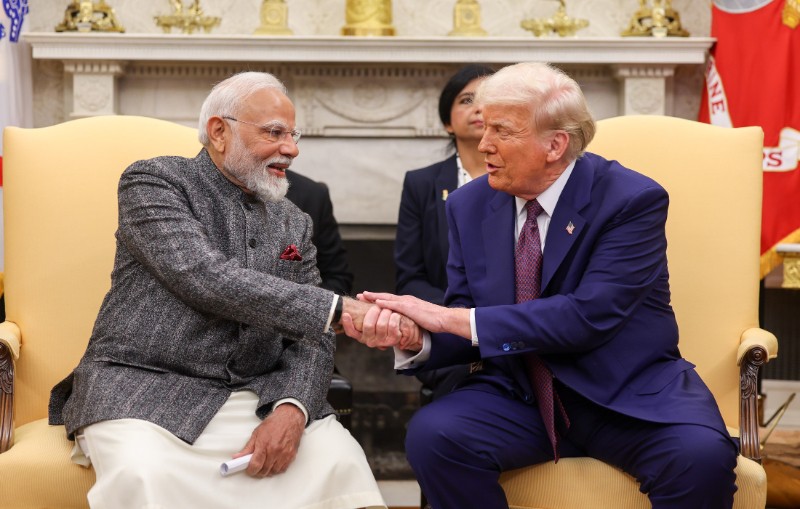
The announcement, made by US President Donald Trump following a call with Prime Minister Narendra Modi, marks one of the most consequential trade developments for India in recent years.
Beyond the headline tariff cut, the deal alters comparative advantages across Asia at a moment when global supply chains are being reconfigured under political and economic pressure.
What the new India–US trade deal delivers
Under the agreement, the United States will reduce tariffs on Indian exports from an earlier combined level of up to 50 percent to a flat 18 percent.
This includes the withdrawal of an additional 25 percent punitive duty imposed over India’s purchases of Russian oil, which had been stacked on top of a 25 percent reciprocal tariff.
Prime Minister Modi welcomed the announcement, highlighting the direct impact on Indian manufacturing and exports.
Modi said the reduced tariff would benefit “Made in India” products and deepen cooperation between the world’s two largest democracies.
President Trump, in turn, framed the deal as a product of close personal ties and strategic alignment, describing Modi as a trusted global partner.
The agreement also includes commitments by India to expand purchases of US energy, technology, agricultural and other products, while moving towards lowering tariffs and non-tariff barriers on American goods.
How India now compares with China, Pakistan and Bangladesh
The most immediate impact of the deal lies in relative positioning.
With an 18 percent tariff rate, India now enjoys more favourable access to the US market than several major Asian exporters.
China continues to face steep US tariffs of around 34 to 37 percent, reflecting the ongoing strategic and economic rivalry between Washington and Beijing.
Bangladesh and Vietnam are subject to duties of 20 percent, while Pakistan faces tariffs of approximately 19 percent despite recent efforts to improve ties with the United States.
This gap, though appearing narrow in percentage terms, carries significant commercial weight.
Even a one or two percentage point difference can influence sourcing decisions for global buyers, particularly in price-sensitive sectors such as textiles, apparel and light manufacturing.
Why the tariff gap matters for Indian exports
Lower tariffs translate directly into improved price competitiveness.
Indian exporters, who had previously been disadvantaged by higher US duties compared to regional rivals, now find themselves in a stronger position across multiple sectors.
The textile and garment industry stands out as a key beneficiary.
The sector is a major employer and heavily dependent on the US market, where it competes directly with Bangladesh, Vietnam and China.
With India now facing lower or comparable tariffs, the playing field has shifted in its favour.
Beyond textiles, the revised tariff regime enhances India’s appeal as global firms reassess supply chains amid geopolitical tensions and trade fragmentation.
The deal strengthens India’s standing at a time when companies are actively diversifying away from China-centric manufacturing models.
A strategic signal from Washington
The trade agreement also carries strategic overtones.
By offering India one of the lowest tariff rates among major Asian economies, the Trump administration has sent a clear signal about its priorities in the region.
While India’s 18 percent tariff is still higher than the rates enjoyed by US partners such as the European Union, Japan, South Korea and the United Kingdom, it places New Delhi firmly ahead of most emerging Asian competitors.
Countries facing significantly higher US duties include Brazil at 50 percent, China at over 30 percent, and several Southeast Asian nations at or above 19 to 20 percent.
According to economists, the outcome underscores India’s growing role in US economic and geopolitical calculations, particularly as Washington seeks reliable partners in an increasingly polarised global trade environment.
What remains unclear about the deal
Despite the scale of the announcement, several details remain unresolved.
The White House has yet to issue a formal presidential proclamation or Federal Register notice required to make the tariff changes legally binding.
There is also no official timeline for when the reduced tariffs will take effect or for the implementation of India’s commitments on energy purchases and trade barrier reductions.
New Delhi has not confirmed claims that India would halt Russian oil imports, and Russia has issued no statement on the matter.
Unlike previous US trade agreements with Japan or South Korea, the announcement did not specify any large-scale investment commitments into US industries.
Support Our Journalism
We cannot do without you.. your contribution supports unbiased journalism
IBNS is not driven by any ism- not wokeism, not racism, not skewed secularism, not hyper right-wing or left liberal ideals, nor by any hardline religious beliefs or hyper nationalism. We want to serve you good old objective news, as they are. We do not judge or preach. We let people decide for themselves. We only try to present factual and well-sourced news.
Support objective journalism for a small contribution.