West Bengal celebrates festival of colours
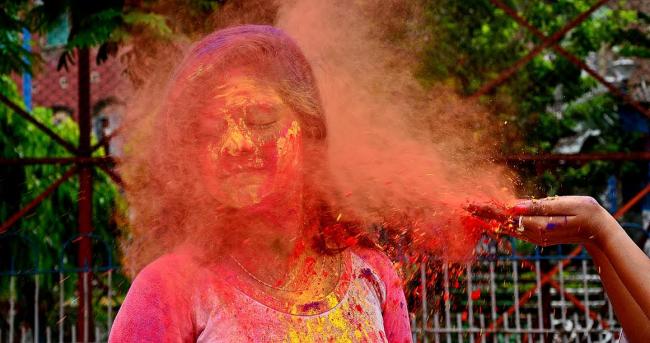
People of all ages smeared each other with gulal and colours to usher in happiness and express compassion.
West Bengal celebrates Holi as the 'Dol Jatra'.
Here the people celebrate this day by placing the idols of Krishna and Radha on a Palki (Palinquin) and they carry them around and play with Abir (Gulal).
It is a ritual on this day for young people to seek blessings from elders by touching their feet with colours.
The Basanta Ustav, as the people of Bengal call it, generally witnesses several cultural programmes on this day in Kolkata and outskirts.
Girls and boys decked in beautiful attires celebrates the festival of colour with free spirit.
The Basanta Utsav is celebrated in a special way, in Santiniketan and Jorasanko Thakur Bari, the places which resided the Nobel laureate Rabindranath Tagore. This festival in every which way is related to the his sonnets, songs, dance forms and literature.
Like all other festivals, food plays an important role in Holi too. In fact, specific platter of sweets are prepared for this particular occasion like Gujiya, Kheer and Thandai.
The entire country will mark the celebrations of Holi on Monday though festivities start a day before, with 'Holika Dahan', a bonfire that marks the burning away of the evil.
The story of this festival dates back to mythological India, as the word Holi comes from the name 'Holika', the sister of king Hiranyakashipu. Hiranyakashipu was adorned with special powers and he thought himself to be inevitable.
Hiranyakashipu's son Prahlada was a devotee of Vishnu and did not believe in his father's rantings. Hiranyakashipu was angered and he tricked Prahlada to sit on the lap of his equally evil sister Holika and ignited the pyre.
Holika was supposed to be immune to the fire but the fire burnt her and encased Prahlada as he prayed to Vishnu. Prahlada lived on.
Next to the Holika dahan, comes the day of Holi, when people gather in huge numbers and play with powdered colours (gulal), water guns and water balloons. Children enjoy the most on this day.
Also, the history of Holi takes us to the Rangpanchami, a 16 days celebration in the Brij region of North India, the birth place of Krishna. Holi festivities mark the mythological union of Krishna with Radha.
image: Avishek Mitra
Support Our Journalism
We cannot do without you.. your contribution supports unbiased journalism
IBNS is not driven by any ism- not wokeism, not racism, not skewed secularism, not hyper right-wing or left liberal ideals, nor by any hardline religious beliefs or hyper nationalism. We want to serve you good old objective news, as they are. We do not judge or preach. We let people decide for themselves. We only try to present factual and well-sourced news.
Support objective journalism for a small contribution.