 Trade Deal
‘Can’t compete with US corporate farming’: Rahul Gandhi hears farmers’ trade deal fears
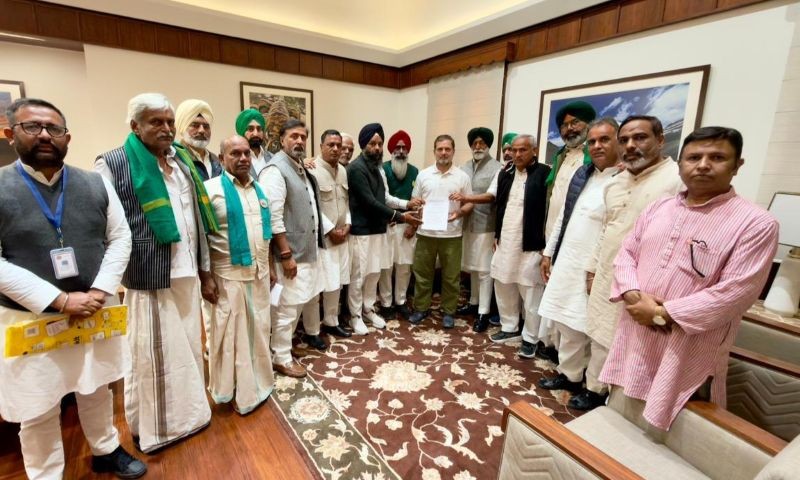
New Delhi/IBNS: Congress MP Rahul Gandhi on Friday met farmer leaders at his Parliament office and heard their concerns over the India-US interim trade deal, media reports said.
The Lok Sabha Leader of Opposition held discussions with representatives of 17 major farmers’ unions from across the country, who warned that the agreement could adversely impact Indian agriculture.
Farmers said the trade deal would hurt cultivators of corn, soyabean, cotton, fruits and nuts due to increased competition from American agricultural products.
“The entire agricultural economy in Madhya Pradesh depends on soybean and maize, and farming contributes nearly 50 percent to the state’s GDP. Ever since the trade deal was announced, soybean prices have declined by 12–15 percent from Rs 5,800 per quintal,” a farmer leader from the BJP-ruled state said.
Another farmer leader added, “Marginal and small farmers in India can never compete with the corporate-style farming system of the United States.”
Sharply criticising Prime Minister Narendra Modi, Gandhi wrote on X: “Narendra ‘surrender’ Modi has betrayed India’s farmers—and the farmers have realised this. This isn’t just a trade deal; it’s a direct assault on the livelihoods of our food providers.”
“This isn’t a fair fight; it’s one-sided pressure. The government’s hollow assurances won’t work anymore. The future of farmers cannot be bartered away without their consent,” he added.
नरेंद्र “surrender” मोदी ने भारत के किसानों के साथ विश्वासघात किया है - और किसान यह बात समझ चुके हैं।
— Rahul Gandhi (@RahulGandhi) February 13, 2026
यह सिर्फ़ एक व्यापार समझौता नहीं है, बल्कि हमारे अन्नदाताओं की आजीविका पर सीधा हमला है।
संसद में आज किसान यूनियनों के प्रतिनिधिमंडल से मुलाक़ात में उनकी चिंता साफ़ दिखी।… pic.twitter.com/YwfnJBMVcD
Union Commerce Minister Piyush Goyal has slammed Gandhi and called his interaction "a stage-managed, most artificial and fake narrative".
"This time, he is shooting from the shoulders of a few Congress party activists who are pretending to be farmer leaders in a completely artificial and baseless conversation," said Goyal.
Farzi Rahul Gandhi… pic.twitter.com/lMMWhj7kKm
— Piyush Goyal (@PiyushGoyal) February 13, 2026
The United States and India last week finalised the framework for an interim trade deal, days after US President Donald Trump announced the long-pending agreement.
Under the deal, the United States will lower tariffs on Indian imports from 25 percent to 18 percent. Trump said the agreement was reached “out of friendship and respect” for Modi and claimed India would eliminate tariffs and non-tariff barriers on US goods.
Trump also stated that India would halt purchases of Russian oil and significantly increase energy imports from the United States, linking the move to broader geopolitical efforts related to the Ukraine war. However, the Indian government has not officially confirmed this claim.
Modi welcomed the tariff reduction, calling it a major boost for Indian exports and bilateral cooperation.
“Wonderful to speak with my dear friend President Trump today. Delighted that Made in India products will now have a reduced tariff of 18 percent. Big thanks to President Trump on behalf of the 1.4 billion people of India for this wonderful announcement,” Modi said.
He added that cooperation between the two countries would unlock “immense opportunities for mutually beneficial cooperation” and contribute to global peace and stability.
Meanwhile, the White House has quietly revised its fact sheet on the trade deal, removing references to “certain pulses” and altering language around a previously mentioned $500 billion purchase commitment, according to media reports.
The original fact sheet had stated that India would “eliminate or reduce tariffs” on all US agricultural products, including certain pulses. However, the revised version no longer mentions pulses—a sensitive sector for India, which is both the world’s largest producer and consumer of pulses.
The revision comes amid growing domestic criticism of the deal and increasing pressure from opposition parties, particularly over concerns that agricultural imports could affect Indian farmers’ livelihoods.
Support Our Journalism
We cannot do without you.. your contribution supports unbiased journalism
IBNS is not driven by any ism- not wokeism, not racism, not skewed secularism, not hyper right-wing or left liberal ideals, nor by any hardline religious beliefs or hyper nationalism. We want to serve you good old objective news, as they are. We do not judge or preach. We let people decide for themselves. We only try to present factual and well-sourced news.
Support objective journalism for a small contribution.