

 Delhi
Delhi
Delhi traders claim Rs 2,000 cr business losses as CJP protests disrupt festive shopping
New Delhi/IBNS: Traders in Delhi have claimed that Cockroach Janta Party (CJP)-led protests over the Special Intensive Revision (SIR) of electoral rolls, along with police barricades and restrictions on market access, have disrupted festive-season business and caused losses estimated at Rs 2,000 crore.
With demonstrations by political groups and opposition parties continuing amid demands for the resignation of Chief Election Commissioner Gyanesh Kumar, traders’ associations have approached the Delhi High Court, the Supreme Court and the government, seeking measures to protect commercial activity during one of the busiest periods of the year.
The concerns have intensified ahead of the Cockroach Janata Party’s (CJP) planned ‘Lehra Do Tiranga’ rally at Central Park in Connaught Place on Friday (October 16).
Traders have warned that restrictions on movement, security arrangements and the possibility of further unrest could discourage shoppers and affect businesses already dealing with reduced customer footfall.
Traders flag Rs 2,000 crore losses
Traders’ associations told the Delhi High Court that barricades and other restrictions introduced in the wake of protests had affected business worth an estimated Rs 2,000 crore.
The court agreed to urgently list petitions from lawyers’ and traders’ bodies seeking a Standard Operating Procedure (SOP) for demonstrations at designated protest venues.
Traders Against CJP Protests: “Our main demand is to prohibit protests within a 3-4 km radius of Connaught Place. They severely impact businesses. On some days, sales drop to zero.” - National Restaurant Association Treasurer Manpreet Singh https://t.co/odApuKz9Ln
— News Arena India (@NewsArenaIndia) October 16, 2026
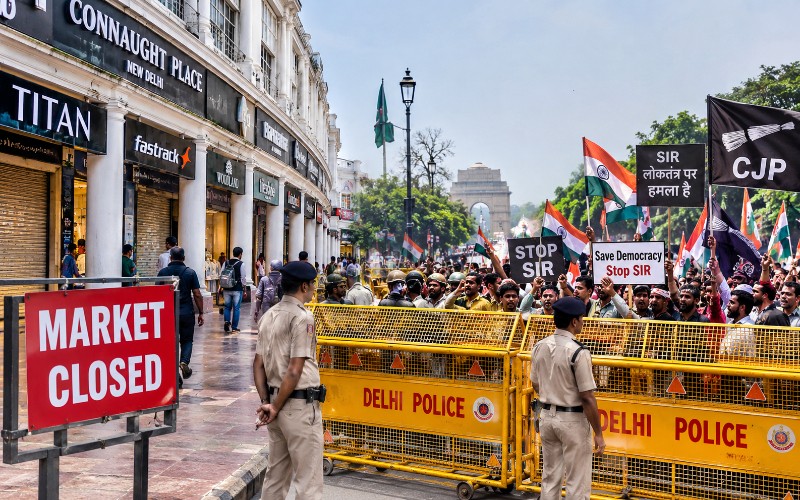
The protests at Jantar Mantar and restrictions across parts of the capital have reportedly affected customer movement in several commercial areas, including Khan Market, Sadar Bazar and Connaught Place.
Traders say customers from the National Capital Region have stayed away because of difficulties accessing markets and concerns about possible confrontations between protesters and police.
The New Delhi Traders’ Association has advised shopkeepers to remain vigilant when deciding whether to open their establishments.
Its president, Atul Bhargava, said traders near the Janpath entry point and Regal crossing had chosen to close their shops because of repeated unrest.
“Traders near the Janpath entry point and Regal crossing decided to keep their shops closed because of frequent unrest in the area. To avoid damage to their shops during altercations between protesters and cops, this was the only option,” Bhargava said, referring to traffic restrictions in the capital.
The claimed Rs 2,000 crore loss reflects the estimate put forward by traders’ bodies; an independently verified assessment of the total economic impact has not been provided in the reports.
Connaught Place businesses raise alarm
Connaught Place, one of Delhi’s prominent commercial districts, has emerged as a particular point of concern for shopkeepers as authorities prepare for the CJP rally.
Traders have reported a sharp decline in footfall amid police barricading and restrictions on access to the area.
Khan Market Traders Association president Sanjeev Mehra previously told ANI that barricades beginning about a kilometre from the market were making it difficult for customers to reach shops.
Mehra said businesses were operating at only 10 to 20 percent of their usual levels, with customers reluctant to visit because of access problems and fears that protests could turn violent.
कॉकरोच दिल्ली के कनॉट प्लेस पर जबरन दुकानों को बंद करवा रहे थे | एक अकेले राष्ट्रवादी दुकानदार ने जलील कर कॉकरोचों को भगा दिया लेकिन दुकान बंद नहीं होने दीं | 🔥 https://t.co/3TD2zmeV9n
— THE JAT ASSOCIATION (@Jatassociation) October 16, 2026
The New Delhi Municipal Council announced that Central Park in Connaught Place would remain closed to the public on October 16 and 17, citing administrative reasons linked to the planned gathering.
The decision has added to concerns among traders and street vendors about the impact of security arrangements on commercial activity.
The Delhi High Court declined to stop the proposed protest but recorded an assurance from the Delhi Police that it would take lawful steps to regulate the gathering and maintain public order.
The Supreme Court also declined immediate intervention in a related plea concerning the park’s closure, while expressing concern about the potential effect on traders’ livelihoods.
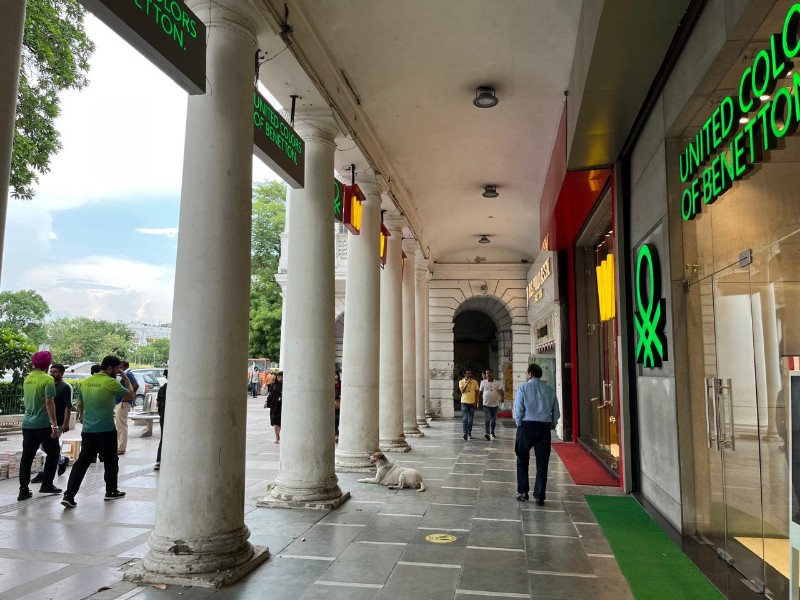 Connaught Place in New Delhi. Photo: Sujoy Dhar/IBNS
Trade bodies' appeal to Rahul Gandhi
The concerns have extended beyond Delhi, with trade and industry associations from several states writing to Congress leader and Leader of the Opposition in the Lok Sabha, Rahul Gandhi, asking him to reconsider the timing and manner of protests over the SIR exercise.
In representations dated October 12 and 13, associations from Delhi, Uttar Pradesh, Rajasthan, Karnataka and Keralam warned that demonstrations, road blockades and restrictions on access could affect businesses during Navratri, Dussehra, Diwali and Chhath Puja.
The Delhi Pradesh unit of the Bhartiya Udyog Vyapar Mandal, represented by its president Naveen Garg, said the festive period was a crucial trading season for millions of traders, employees and their families.
It warned that uncertainty, shop closures and potential damage to commercial property could deepen the difficulties facing the business community.
The Federation of Trade and Industry of India (FTII) also urged Gandhi to reconsider the agitation’s timing, citing concerns about falling footfall and lost sales.
“We respect the right of every political party and citizen to raise concerns and pursue democratic remedies,” the federation said.
“Thousands of small traders, shopkeepers, employees and daily-wage workers depend on this season for their livelihoods. Their businesses should not become collateral damage in a political dispute,” it added.
The federation called for street-level agitation to be paused during the festive shopping period, suggesting that political concerns could instead be pursued through dialogue and appropriate democratic or legal channels.
The Uttar Pradesh Udyog Vyapar Mandal and the Indian Recovered Paper Traders Association also raised concerns about the potential economic consequences of continued demonstrations.
Associations seek PM and CJI intervention
Several trade bodies have separately appealed to Prime Minister Narendra Modi and Chief Justice of India Surya Kant for protection against disruptions to commercial activity.
In Rajasthan, the Jaipur Vyapar Mahasangh, led by president Subhash Goyal, wrote to Gandhi on October 12, alleging that demonstrations were affecting small shopkeepers and employees.
The association subsequently approached Modi and the Chief Justice, seeking safeguards for commercial centres and measures to prevent disruptions to trade, employment and investment.
People In Connaught place Gathering In support of Government and Shop keepers As Shop keepers Face losses due to these CJP Protesters https://t.co/tUvmnWOtuS
— INDIAN (@hindus47) October 16, 2026
In Delhi, organisations including the New Delhi Traders’ Association, Mayapuri Industrial Welfare Association, Nai Sarak Traders Association, Janpath Traders Association and Chawri Bazar Hardware Association called for stronger administrative and legal measures to prevent forced market closures, road blockades and restrictions on the movement of customers and goods.
The Federation of All India Distributors Associations (FAIDA), in a representation dated October 12, sought urgent judicial intervention against what it described as disruptive demonstrations affecting commercial centres and the wider economy.
“Weaponising street protests to choke arterial highways, block public transit, and force market shutdowns during our peak festive season is an outright abuse of democratic freedom,” the federation stated in its letter.
FAIDA urged the Supreme Court to issue directions to keep commercial corridors clear and confine disruptive demonstrations to designated locations away from business districts.
The Bangalore Wholesale Cloth Merchants Association also approached the Chief Justice, warning that interruptions to trading could hurt family-run businesses that had invested heavily in festive-season stock.
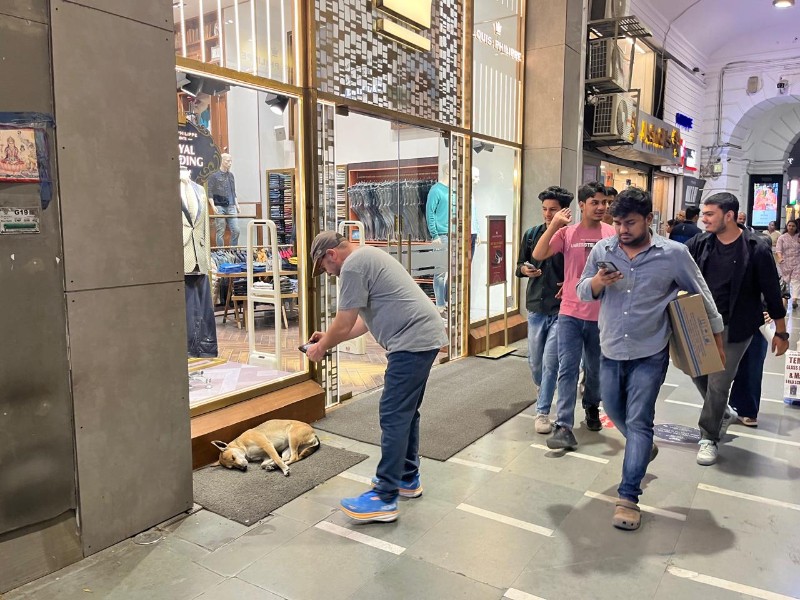 Connaught Place in New Delhi. Photo: Sujoy Dhar/IBNS
In a separate representation to the Prime Minister, it sought measures to protect commercial establishments while respecting the right to peaceful protest.
The Mahila Vyapar Mahasangh Sansthan highlighted the difficulties faced by women entrepreneurs, artisans and small businesses during periods of commercial disruption.
The Narela Food Processing Industries Welfare Association and the Dall & Besan Millers Association, Delhi, raised concerns about the potential impact on industrial operations, supply chains and employment.
In Keralam, the Calicut Chamber of Commerce & Industry urged the Centre to protect markets, commercial establishments and major transport routes during public demonstrations.
“We firmly believe that the democratic right to protest must be respected while ensuring that it does not unlawfully deprive traders and the public of their right to conduct legitimate economic activities,” the chamber said.
❗Delhi’s Connaught Place Wears An Eerie, Empty Look Ahead Of CJP March The Cockroach Janta Party’s Tiranga Yatra is scheduled for today, with Delhi Police planning to deploy over 6,000 personnel across Lutyens’ Delhi and surrounding areas. Prohibitory orders are in force across the area, while Central Park remains closed to the public on Oct 16 & 17. Authorities have also warned of possible traffic restrictions around CP. 📹 ANI
— RT_India (@RT_India_news) October 16, 2026
Protests over electoral roll revision
The demonstrations centre on opposition to the Election Commission’s Special Intensive Revision of electoral rolls and demands for the resignation of Chief Election Commissioner Gyanesh Kumar.
Opposition parties have alleged irregularities in the exercise, while the Election Commission has disputed claims that the revision is politically motivated.
On October 12, INDIA bloc leaders marched towards the Supreme Court and submitted a petition challenging the exercise.
The petition sought suspension of the ongoing revision pending adjudication and the formation of an independent committee headed by a retired Supreme Court judge to examine its implementation.
The protests have prompted heightened security measures and restrictions in parts of Delhi.
Authorities have also designated alternative locations for demonstrations, including Ramlila Ground, Burari Ground and CBD Ground, following changes to the arrangements governing protest venues.
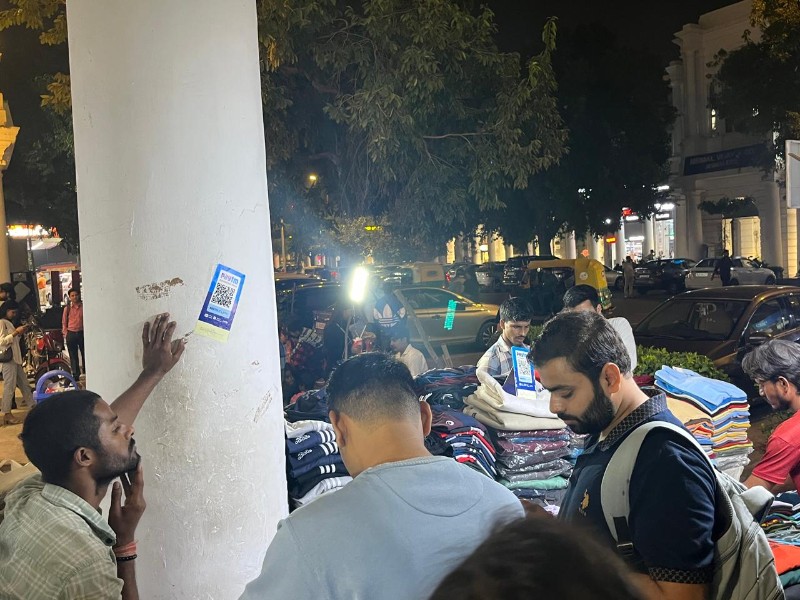 Connaught Place in New Delhi. Photo: Sujoy Dhar/IBNS
As the festive shopping season continues, traders’ associations are seeking assurances that commercial districts will remain accessible to shoppers, workers and suppliers.
Their representations broadly argue that while peaceful protest is a democratic right, road blockades and restrictions on access can affect businesses that depend on seasonal sales.
The scale of the losses claimed by the associations has not been independently established, but their appeals have brought the potential impact of protest-related restrictions on Delhi’s markets and businesses into the legal and political debate.
Support Our Journalism
We cannot do without you.. your contribution supports unbiased journalism
IBNS is not driven by any ism- not wokeism, not racism, not skewed secularism, not hyper right-wing or left liberal ideals, nor by any hardline religious beliefs or hyper nationalism. We want to serve you good old objective news, as they are. We do not judge or preach. We let people decide for themselves. We only try to present factual and well-sourced news.
Support objective journalism for a small contribution.