 Khalistan
Extremism over diplomacy: Undermining Canadian trade, growth and progress
Recent events in Surrey, British Columbia, have brought to the forefront reality of Khalistan extremism, a movement that has far-reaching implications for India-Canada relations, international trade, and the stability of the global economy.
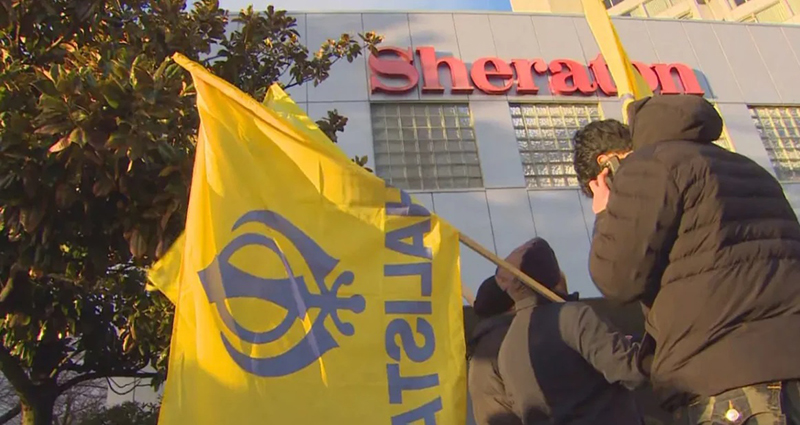
On a seemingly ordinary evening, dozens of Sikh activists gathered outside the Sheraton Guildford Hotel to protest the presence of Sanjay Kumar Verma, India’s High Commissioner to Canada, at a trade forum hosted by the Surrey Board of Trade.
The protests, however, were not merely about the diplomat’s visit; they were emblematic of a larger, more insidious agenda that seeks to disrupt the burgeoning trade relations between India and Canada and propagate anti-India sentiments under the guise of advocating for an independent Sikh homeland, known as Khalistan.
The recent protests in Surrey underscore a troubling trend: the hijacking of legitimate political discourse by extremist elements who are more interested in sowing discord than in engaging in constructive dialogue. The demonstrators, waving yellow Khalistan flags and chanting anti-India slogans, were not merely expressing their political views; they were actively working to undermine the diplomatic and economic ties between India and Canada, ties that are vital to both nations.
This kind of extremism is not just anti-India; it is anti-peace and anti-progress. By targeting events aimed at strengthening trade relations, Khalistan extremists are attempting to derail discussions that could lead to economic opportunities benefiting millions of people in both countries. India is British Columbia’s fifth-largest trade partner, with trade between Canada and India reaching a record $20 billion in 2022. Disrupting these discussions not only hurts businesses but also jeopardizes jobs and economic growth, particularly in industries that rely on stable international relations.
The question that arises is: Why does the Canadian government, particularly under Prime Minister Justin Trudeau’s administration, appear to tolerate, and at times even encourage, such extremism? The answer may lie in political expediency. Canada has a significant Sikh population, many of whom are concentrated in key electoral districts. By allowing Khalistan extremists to operate with impunity, the Trudeau administration may be attempting to appease a vocal minority in exchange for political support. This strategy, however, is fraught with risks.
First and foremost, it undermines Canada’s standing as a nation that champions human rights and opposes extremism in all its forms. By turning a blind eye to the activities of Khalistan extremists, the Trudeau administration is tacitly endorsing a movement that seeks to destabilize a democratic ally and disrupt global trade. Moreover, this approach alienates the broader Canadian population, who may view the government’s inaction as a betrayal of the values that Canada purports to uphold.
Secondly, it sends a dangerous message to other extremist groups around the world: that extremism can be a viable path to achieving political goals, provided it is wrapped in the rhetoric of social justice or minority rights. This not only emboldens other separatist movements but also risks dragging Canada into international conflicts that it has no reason to be involved in.
If Canada is to maintain its reputation as a global leader in human rights and international diplomacy, it must take a firm stance against all forms of extremism, including Khalistan extremism. This means cracking down on those who seek to disrupt diplomatic and economic ties between Canada and India and ensuring that trade talks are not hijacked by fringe groups with their own agendas.
The Trudeau administration must recognize that by allowing Khalistan extremists to operate freely, it is not just appeasing a handful of voters; it is endangering the economic and diplomatic interests of the entire nation. Canada and India have much to gain from deepening their economic ties, and this potential should not be sacrificed on the altar of political expediency.
(Image and text courtesy: Khalsavox.com)
Support Our Journalism
We cannot do without you.. your contribution supports unbiased journalism
IBNS is not driven by any ism- not wokeism, not racism, not skewed secularism, not hyper right-wing or left liberal ideals, nor by any hardline religious beliefs or hyper nationalism. We want to serve you good old objective news, as they are. We do not judge or preach. We let people decide for themselves. We only try to present factual and well-sourced news.
Support objective journalism for a small contribution.