From the Streets to the Dust: BJP Ends Mamata's Reign as Bengal's Anger Finds Its Ballot
A young woman doctor was raped and murdered inside a seminar room of a government medical college. Her parents sat vigil outside the hospital, broken and grieving. The state did not stand with them. It tried to manage the story. Allegedly, they slowed the investigation and tampered with evidence. Protect its own.
Inside a college union room in the beating heart of South Kolkata, another woman was raped by a group of Trinamool Congress functionaries last year.
Thousands of teachers cleared competitive exams, waited years, and built their lives around a government job. Then they lost everything — because their appointments had been sold to the highest bidder by Mamata's own Education Minister. His aide was found with Rs 21 crore in cash. Stuffed inside a South Kolkata apartment.
In Murshidabad, Hindu families were killed. Homes torched. Temples desecrated. Four hundred families fled to Malda — refugees in their own country. The Chief Minister looked the other way. She was counting the votes their attackers would deliver.
A professor at Calcutta University said she had to pay Rs 11 lakh to TMC-linked strongmen. Just to construct the building that would be a business address. On land she already owned.
This is the Bengal that voted on April 23 and April 29, 2026. Not the Bengal of Rabindrasangeet and adda, of mishti doi and revolutionary poetry — though that Bengal exists and always will. This is the Bengal that had had enough. Enough of the syndicate at the gate. Enough of the phone call that made cases disappear. Enough of the goddess who demanded worship while delivering impunity. When these people walked into the booth, they did not carry a party flag in their hearts. They carried a rage that had been building for years — and they gave it, finally, to the BJP.
An Era Ends
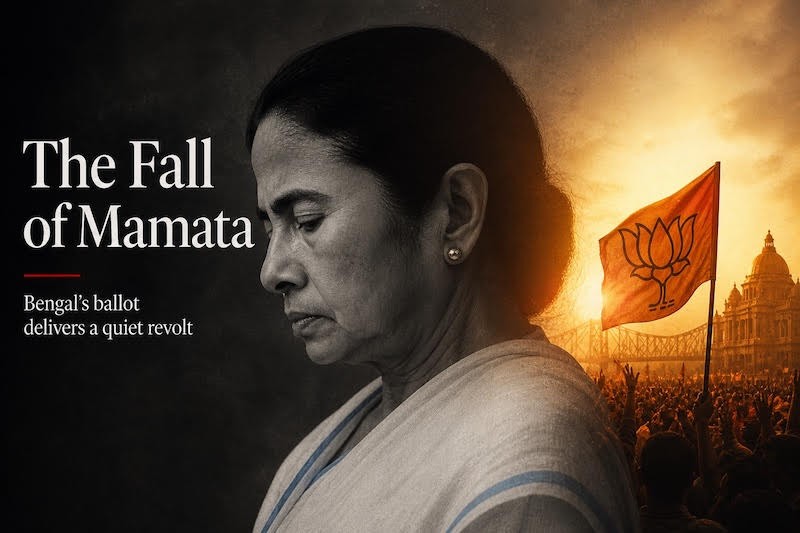
For over fourteen years, Mamata Banerjee ruled West Bengal the way no politician in independent India's history had — simultaneously the goddess of street agitation and the undisputed feudal empress of a state she had personally wrenched from the Left's iron grip. On Monday morning, May 4, 2026, that era ended. The ballot box delivered its verdict with brutal finality.
By mid-morning on counting day, the BJP had crossed the 148-seat majority mark and was leading in over 190 assembly constituencies when this article was written. Mamata Banerjee's TMC was leading in just 95 seats. And in the cruelest symbolism of all, the Chief Minister herself was trailing in her Bhabanipur stronghold behind BJP's Suvendu Adhikari — the man she once called a traitor and expected to humiliate a second time.
Bengal had spoken. But what exactly did it say?
Not just a vote for the BJP. A Vote Against Mamata
Let us be clear about what happened here. This was not solely a wave of ideological conversion. West Bengal did not suddenly fall in love with the BJP. What it did — decisively, massively, in booths from Howrah to North 24 Parganas — was repudiate a woman, a government, and a system of rule that had corroded the state's public institutions, corrupted its economy from the neighbourhood up, and gambled recklessly with its social fabric.
As Suvendu Adhikari declared from the counting centre: "This time there was a Hindu consolidation, and the way Muslims vote for TMC, they have not done that this time." That is one part of the picture. But the other, equally important part is that Mamata gave people no choice but to leave.
The Match That Lit the Fire: RG Kar
The single event that cracked open Mamata's political fortress was the rape and murder of a 31-year-old postgraduate medical student at RG Kar Medical College and Hospital on the night of August 9, 2024.
Her body was found in a seminar room on campus. A 33-year-old civic volunteer named Sanjay Roy was arrested within a day. Three days later, the Calcutta High Court transferred the investigation to the CBI, stating that the Kolkata Police's probe did not inspire confidence.
.jpg)
What followed was unprecedented in modern Bengal. Junior doctors struck for 42 days. Thousands took to the streets — not TMC cadres performing political theatre, but ordinary citizens: women in sarees, students with candles, retired professors, homemakers, software engineers. This was the Kolkata that Mamata had always claimed as her own. It was no longer hers.
On August 27, a massive rally called Nabanna Abhijan — March to Nabanna, the Bengal secretariat — was organised by the Paschim Banga Chhatra Samaj and the BJP. The Kolkata Police termed the march illegal, erected barricades and used lathis, water cannons and tear gas to disperse the crowd. The images of the crackdown spread across the internet in hours. Mamata had done the unthinkable — she had used the state apparatus against grieving people demanding justice for a dead woman doctor.
The public never forgave her.
The Scam That Stole a Generation's Dreams
If RG Kar was the emotional trigger, the West Bengal SSC teachers' recruitment scam was the institutional rot laid bare. The scam involved large-scale irregularities in the hiring of teachers and non-teaching staff for state-run schools through the School Service Commission. OMR sheets were allegedly tampered with, merit lists manipulated, and fake appointment letters issued.
Several candidates allegedly paid bribes of Rs 5–15 lakh to secure jobs, while some who never appeared for the exam were given appointments.
The Enforcement Directorate arrested Partha Chatterjee — the TMC's secretary-general, a five-time MLA, and the state Education Minister when the scam occurred — on July 23, 2022. Raids at the home of his close aide Arpita Mukherjee recovered over Rs 21 crore in cash, jewellery worth more than Rs 50 lakh, foreign currency worth Rs 54 lakh, and 22 mobile phones.
.jpg)
On April 22, 2024, the Calcutta High Court declared the entire selection process null and void and ordered the termination of 25,753 teachers and non-teaching staff. The Supreme Court upheld this verdict. Tens of thousands of young men and women — many of whom had legitimately cleared the exams — lost their livelihoods because the system was rotten at its core. Their anger, and that of their families, simmered through every phase of this election.
The Fear That Dare Not Speak Its Name: The Hindu Question
Alongside the immediate triggers was something deeper, older and more combustible — a growing anxiety among Hindus about demographic change, communal violence and what they perceived as Mamata's brazen appeasement of the Muslim vote bloc.
It was not an irrational fear conjured by propaganda. The events on the border told their own story. Following Sheikh Hasina's resignation in August 2024, attacks on Hindus in Bangladesh surged, with Hindu homes, businesses and places of worship being targeted across the country. One advocacy group documented more than 2,500 violent incidents against religious minorities between Hasina's ouster and December 2025, including 66 people killed.
The images and stories from across the border flowed freely into Bengali homes via social media. Hindu Bengalis watched, recognised the landscape, the language, the faces — and felt a cold dread.
.jpg)
Closer home, the Murshidabad violence of 2025 — which began as a protest over the Waqf Act but escalated into targeted attacks on Hindus — forced 400 Hindu families to be displaced to neighbouring Malda. Homes, shops, temples and public property were destroyed, National Highway 12 was blockaded and Nimtita railway station was vandalised. Three people were killed. The West Bengal government's response was widely criticised as negligent.
Meanwhile, something subtler but equally powerful was happening in Bengali neighbourhoods across the state. The visible assertion of religious identity — more hijabs, more burqas in localities where they had once been rare — unsettled Hindu residents who read it as a cultural shift they had not voted for and that their government was actively enabling by playing vote-bank politics. Mamata had made no secret of her alliances — she attended iftar parties, covered her head like a Muslim woman, and structured welfare schemes in ways many Hindus believed disproportionately favoured minorities.
The BJP's Special Intensive Revision of electoral rolls, which led to the deletion of nearly 91 lakh names from the voter list, became a major flashpoint. The BJP maintained it eliminated illegal entrants; the TMC alleged genuine voters — particularly minorities and migrant workers — had been disenfranchised. Whatever the reality, the revision reshaped the electorate in ways that benefited the BJP.
The Syndicate, the Extortion and the Everyday Horror
Beyond the headlines was the grinding, daily humiliation of ordinary Bengali life under TMC's syndicate raj. In every lane, at every construction site, across every fair price shop, the party's local strongmen extracted their cut. No one was spared.
An academic from Calcutta University—who asked not to be named—described how she paid Rs 11 lakh in extortion money to local TMC-linked operatives for a building that was meant to be a business address in employment parched Bengal, before a single brick was laid. "This is not politics," she said. "This is organised crime wearing a political uniform."
Local media, too, was not spared. Mamata's government became adept at buying favourable coverage — advertising money, newsprint allocations, invitations to official functions — while journalists who stepped out of line found themselves frozen out or worse.
Poets, writers, actors and intellectuals were kept on payrolls, feted at Rabindra Sadan and invited to Nabanna receptions — as long as they asked no questions. Even Bengal's once-proud film industry found its creative freedom constrained, its awards politicised, its stars expected to perform at TMC rallies. Those who did not fall in line faced unofficial bans.
The List That Changed Everything: Why Hindus Welcomed the SIR
Before a single vote was cast, the ground beneath this election had already shifted. The instrument was the Special Intensive Revision (SIR) of electoral rolls—announced by the Election Commission in October 2025 and immediately denounced by Mamata Banerjee as a BJP conspiracy to erase minority voters.
Nearly 91 lakh names were deleted from West Bengal's voter list. The districts hit hardest — Murshidabad, North 24 Parganas, Malda, Nadia, South 24 Parganas — were precisely the border districts where illegal immigration from Bangladesh had for years been an open, festering secret.
.jpg)
Mamata screamed disenfranchisement. But in Hindu households across these districts, the reaction was strikingly different. Here, finally, was someone doing what no government in Bengal had dared to do for decades—looking at the rolls, asking hard questions, removing names that had no business being there. Voters who had watched their neighbourhoods change and their political voice drowned out by what they believed were manufactured Muslim majorities felt, for the first time in years, that the system was working for them.
The ECI had cited concerns that several voters were illegal immigrants from Bangladesh who had obtained voter identity cards using forged Aadhaar cards, voter cards and ration cards through brokers and local political figures. For ordinary Hindus in border districts, this was not a revelation. It was confirmation of what they had lived with for years.
What should have been a routine correction turned into a confrontation reaching from the streets to the Supreme Court. Mamata mobilised. Protests erupted. But the louder she screamed, the more convinced many Hindu voters became that she was protecting exactly the voters she had always protected — at their expense.
And then came polling day—and something Bengal had not seen in a generation. Over 3.5 lakh security personnel were deployed statewide, with 2,550 companies of central armed police forces and 142 general observers across all constituencies. In booth after booth, in districts where TMC musclemen had for years decided who voted and who did not, ordinary citizens walked in without fear. For the first time in living memory, Bengal voted freely. The Election Commission had given them that. And they used it.
The SIR, however controversial it might be, did not just clean a voter list. The central forces did not just guard a booth. Together, they sent a signal. And on May 4, Bengal signalled back.
The BJP Bengal Finally United — And the RSS That Made It Possible
For much of the last decade, the BJP's biggest enemy in Bengal was itself. Factional infighting, outsider leadership, Hindi-belt cultural clumsiness — all had limited its reach into a state with fierce pride in its Bengali identity. That changed.
The 2021 election — in which the BJP won 77 seats despite losing — planted a deep network of booth-level workers. According to one political analyst while Bengali political consciousness, shaped by decades of ideological struggle, resists purely nationalist or welfare-based appeals — BJP's strategic shift from criticising Mamata to building an alternative administrative credibility did make inroads.
.jpg)
The real unsung story is the RSS. For years, the Sangh's pracharaks worked silently through flood relief, COVID vaccination drives and educational programmes in districts that neither the Left nor the BJP had previously penetrated. In Murshidabad, in Nadia, in parts of North 24 Parganas — RSS-affiliated organisations ran evening schools, organised Durga Puja committees, and over years built both social capital and political trust. When the election came, that network delivered.
Suvendu Adhikari — Mamata's former lieutenant who became her most determined nemesis — proved to be the right face for the moment: Bengali, grounded, willing to speak the unspoken anxiety of Hindu voters without the clumsiness of the party's Delhi leadership.
The City That Wore Her Face Brazenly
.jpg)
No Indian city has ever been colonised by a single politician's face the way Kolkata was under Mamata Banerjee. She was everywhere — and that is not a figure of speech. Her photograph stared down from hoardings outside hospitals, railway stations, state-run museums and even the city's iconic Kali temple. Government buildings that had no business displaying a party leader's portrait wore her image like a compulsory uniform, even international film festivals and foreign consulates in Kolkata were not spared.
No public or private space was spared, not even the German consulate wall. It was visually hideous. Garish, omnipresent, inescapable — an aesthetic assault on a city that had given the world Tagore, Ray and Bose, a city that wore its cultural identity like a second skin and considered itself the intellectual capital of the nation. It was not governance. It was an occupation. A relentless, suffocating cult of personality that Kolkata's proud citizens tolerated in silence — until, on May 4, they decisively did not.
The Verdict of History
The elections witnessed a 92.47 per cent voter turnout — one of the highest in Indian electoral history for a state assembly election — a number that, in itself, speaks to the depth of public engagement and urgency. These were not voters going through a routine civic exercise. They were people who had made up their minds, who had waited, who had something they needed to say.
Mamata Banerjee rose from the streets. She toppled the communists after 34 years of unbroken Left rule. She was fearless, mercurial, brilliant in her political instincts — a woman who once slept on the road to protest the Left. History will record all of that. But history will also record what she did with power when she had it — the corruption she enabled, the institutions she hollowed out, the communities she played against each other, the dead woman doctor whose justice she tried to obstruct.
Bengal voted on all of it. And Bengal rewrote history once again, giving its answer.

Sujoy Dhar is the Group Editor of IBNS and its affiliated platforms.
Support Our Journalism
We cannot do without you.. your contribution supports unbiased journalism
IBNS is not driven by any ism- not wokeism, not racism, not skewed secularism, not hyper right-wing or left liberal ideals, nor by any hardline religious beliefs or hyper nationalism. We want to serve you good old objective news, as they are. We do not judge or preach. We let people decide for themselves. We only try to present factual and well-sourced news.
Support objective journalism for a small contribution.