India-Canada ties turn a corner: ‘By December, we will have a free trade agreement,’ says Consul General Mahaveer Singhvi
After years of bitterness, India-Canada ties are gaining fresh momentum, with trade at the heart of the reset. With CEPA negotiations progressing, Consul General in Toronto Mahaveer Singhvi says the two countries are working to conclude the agreement (FTA) by December 2026. Energy, critical minerals, AI, textiles, investment and the Indian diaspora offer major opportunities for cooperation. Singhvi spoke to IBNS Editor Sujoy Dhar and Canada correspondent Suman Das about the road ahead, economic ties and the security challenges that remain.
Q: After a period of considerable bitterness in India-Canada relations, there now appears to be a clear change in the atmosphere. How do you see the relationship today?
A: There is good momentum now. We should double our trade, and the trajectory is good. There have been multiple visits, including several ministerial visits, and there is a much greater focus on strengthening the economic relationship. The two countries have agreed to move ahead with the Comprehensive Economic Partnership Agreement, or CEPA.
Q: Trade seems to be the biggest opportunity in this reset. Where do things stand on the proposed trade agreement?
A: We are discussing free trade and there is very good momentum. By December 2026, we will have the free trade agreement. The CEPA is a very important part of the relationship going forward.
(India and Canada have formally launched negotiations for a new Free Trade Agreement (FTA), officially referred to as the Comprehensive Economic Partnership Agreement (CEPA), covering goods, services, investment, agriculture and agri-food, digital trade, mobility and sustainable development. Both sides have set the objective of more than doubling two-way trade to US$70 billion by 2030, with Canada expecting the CEPA/FTA to conclude by the end of 2026.)
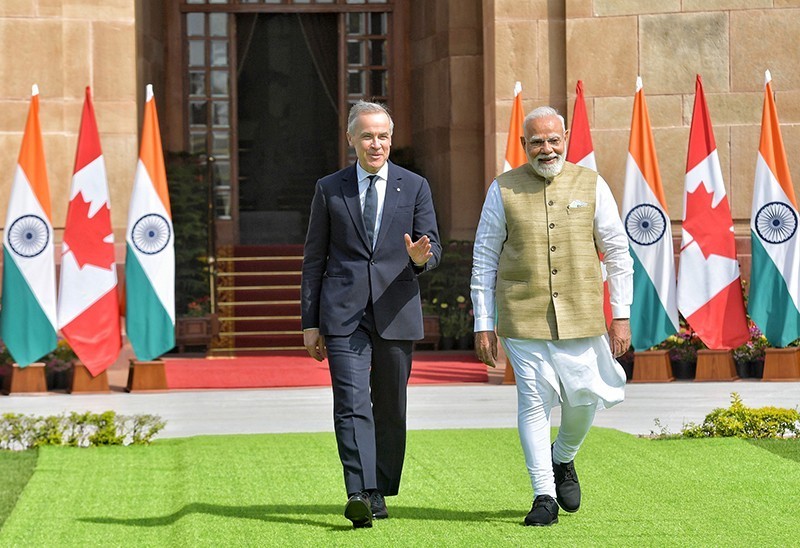 Mark Carney met PM Modi in New Delhi in March 2026. Photo: PIB
Q: What would a CEPA mean in practical terms for businesses and consumers in both countries?
A: It will create much greater opportunities. India and Canada are complementary economies. We are not competing with each other; we can complement each other in many areas. A more predictable trading framework can help businesses look at the two markets with greater confidence.
Q: Which sectors do you see as having the greatest potential?
A: There are many areas. Artificial intelligence, critical minerals, energy, technology, investment and manufacturing can all see greater cooperation. There is a very large opportunity because our economies have different strengths.
(Canada has important resources and capabilities, while India has a huge market, a strong technology and services sector and a large manufacturing base. The idea should be to create partnerships rather than simply look at trade as a one-way relationship.)
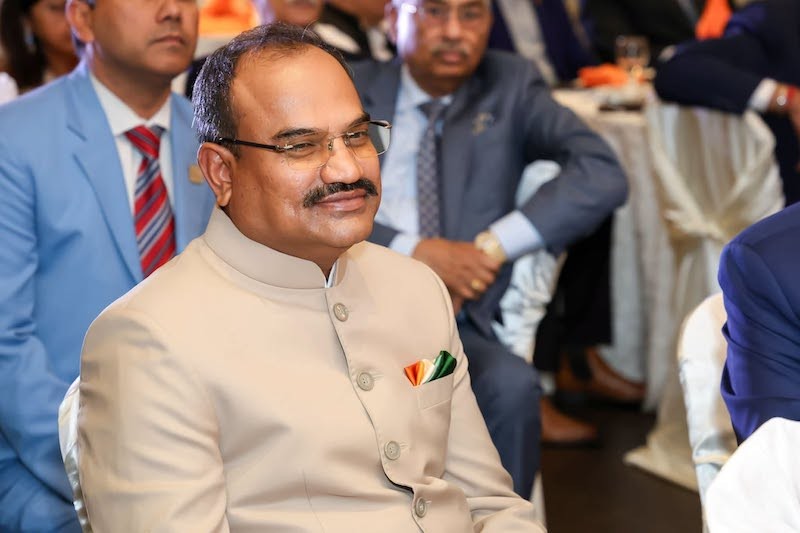 Consul General Singhvi at an Indian I-Day function in Toronto. Photo: FB/Indian Consulate
Q: Textiles are an important part of India's export basket. How do you see that sector in the Canada market?
A: Textiles and garments are certainly an important area of potential.
(India has a very strong textile and apparel industry, with capabilities ranging from yarn and fabrics to finished garments and traditional products. Better market access under a trade agreement can create opportunities for Indian exporters while Canadian consumers and businesses can benefit from greater choice. Canada's current trade data show that Indian merchandise imports into Canada are already significant and growing. In 2025, Canadian merchandise imports from India reached C$9.7 billion, up 20.6 per cent from the previous year.)
Q: Canada is also looking at critical minerals and energy. Could this become another major pillar of the relationship?
A: Absolutely. Critical minerals, energy and technology are areas where there is enormous potential. Canada has resources, and India has a growing economy and growing energy and technology requirements. There can be cooperation in minerals, energy, AI and other emerging sectors.
(The two governments have already announced a Strategic Energy Partnership covering areas including LNG, LPG, uranium, solar and hydrogen, alongside cooperation on critical minerals.)
Q: High-level visits are important because they give political momentum to the relationship and also encourage business and ministerial engagement. How significant would another Modi visit be for the relationship?
A: Prime Minister Carney has invited Prime Minister Modi to Canada while we aim to have the FTA by end of December.
(The two prime ministers have already agreed on the importance of regular reciprocal high-level visits, including visits by ministers and business leaders.)
Q: We have also seen a very strong Indian business presence in Canada recently. Piyush Goyal's visit brought a large delegation. What does that indicate?
A: It shows the seriousness of the economic relationship. Minister Piyush Goyal came with a very large business delegation—around 120 delegates—and there were extensive discussions with Canadian counterparts and businesses. The private sector has an important role to play in taking the relationship forward.
(Canada itself described Goyal's May 2026 visit as bringing the largest-ever trade delegation from India to Canada, as both sides sought to accelerate progress towards the CEPA and the goal of doubling trade.)
Q: The Indian diaspora is often described as a bridge between the two countries. How important is it economically?
A: The diaspora is a very positive influence. It has tremendous potential in trade, investment and the wider economy. People who have links with both countries understand both markets, and they can facilitate business, investment and knowledge transfer.
The diaspora should be seen not only from a cultural perspective but also as an important economic bridge between India and Canada.
Q: Let us come to the difficult part of the relationship. Security concerns, particularly those relating to Khalistani extremism, have been a major source of tension. Do you see a change there?
A: There is now a security dialogue between the two National Security Advisers. Security is a concern of both countries, and dialogue is important.
There has also been an important development regarding the Air India Kanishka bombing. Canada has now acknowledged that the 1985 bombing was carried out by Canada-based Khalistani extremists. This recognition is significant after so many years.
(The Canadian Security Intelligence Service (CSIS) in June 2026 explicitly stated that a bomb planted by Canada-based Khalistani extremists destroyed Air India Flight 182, killing all 329 people aboard.)
Q: So, after the bitterness of the past few years, are you optimistic about the relationship?
A: Yes. I am optimistic because there is momentum. There is political engagement, there is ministerial engagement, there is business engagement and there is a clear economic opportunity.
India and Canada complement each other. If we can double our trade and build stronger cooperation in areas such as AI, critical minerals, energy, textiles, investment and technology, the relationship can become much stronger.
The CEPA will be an important milestone. The objective should be to build a relationship based on trade, investment, technology, security and people-to-people connections.
Support Our Journalism
We cannot do without you.. your contribution supports unbiased journalism
IBNS is not driven by any ism- not wokeism, not racism, not skewed secularism, not hyper right-wing or left liberal ideals, nor by any hardline religious beliefs or hyper nationalism. We want to serve you good old objective news, as they are. We do not judge or preach. We let people decide for themselves. We only try to present factual and well-sourced news.
Support objective journalism for a small contribution.