Opposition vows to fight Women's Quota Bill over ‘politicised’ delimitation plan
The Congress and several Opposition parties on Tuesday said they support the Women’s Reservation Bill in principle but will oppose the government’s approach to implementing it through delimitation, calling the move politically motivated.
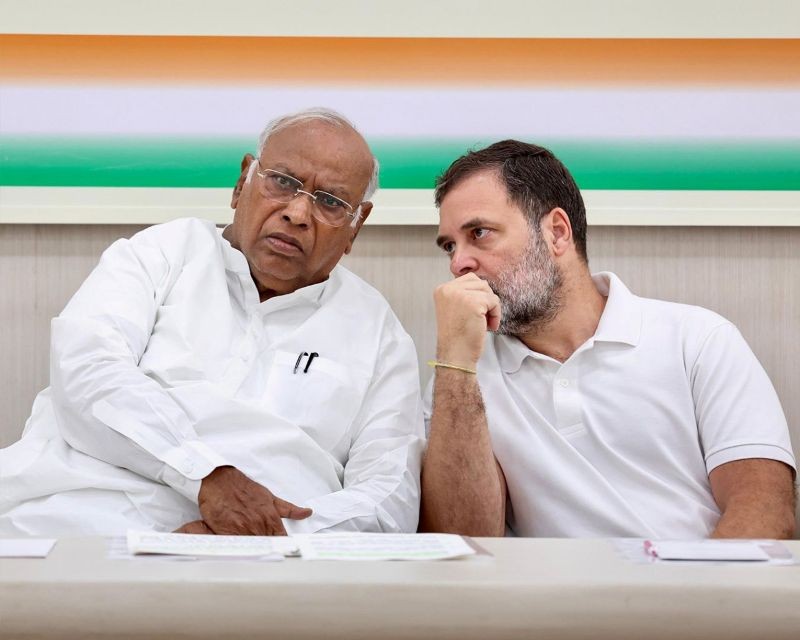
Addressing a joint press conference after a meeting of Opposition leaders, Congress president Mallikarjun Kharge said the government was attempting to “gag and suppress” dissent.
“We are in support of the Women’s Reservation Bill, but we object to the government’s approach. The action is politically motivated,” Kharge said, adding that the Opposition would fight the proposal in Parliament.
The remarks come ahead of an extended Budget session starting April 16, where the Centre is expected to table a set of bills, including constitutional amendments tied to the quota’s implementation.
Congress leader Jairam Ramesh alleged that the Delimitation Commission was being used as a political tool. “Women’s reservation should be implemented, but we are totally against delimitation,” he said.
Rahul Gandhi's message
Echoing the concern, Rahul Gandhi accused the government of attempting a “power grab” through gerrymandering.
In a post on X, he warned that the move could undermine representation for OBCs, Dalits, Adivasis, and states in southern and northeastern India.
Congress party unequivocally supports Women’s Reservation. Parliament unanimously passed the bill in 2023, it is already part of our Constitution.
— Rahul Gandhi (@RahulGandhi) April 15, 2026
What the government is proposing now has nothing to do with women’s reservation. This amendment is an attempted power grab using… pic.twitter.com/FFI2LwHBk4
Numbers complicate passage
While the Women’s Reservation Bill itself enjoys broad support, related constitutional amendments require a two-thirds majority in both Houses of Parliament.
The ruling NDA currently falls short of this threshold in both the Lok Sabha and Rajya Sabha, making Opposition backing crucial.
Delimitation at the core of dispute
At the heart of the row is the proposed Delimitation Bill, which seeks to redraw constituencies based on the 2011 Census and increase Lok Sabha seats from 543 to as many as 850 to operationalise the quota before the 2029 general elections.
Opposition parties argue that this formula would disproportionately benefit northern states with higher population growth, reducing the parliamentary share of southern states that have controlled population growth more effectively.
Leaders from regional parties have also voiced concern. Jammu and Kashmir Chief Minister Omar Abdullah warned that past delimitation exercises appeared to favour the BJP, while DMK MP Kanimozhi said the move could “badly affect” southern states.
Even parties that have previously supported the government, such as the BJD led by Naveen Patnaik, have adopted a cautious stance, indicating support would depend on safeguarding their state’s political representation.
Broad opposition unity
The Opposition meeting saw participation from leaders across parties, including DMK, RJD, Trinamool Congress, Shiv Sena (UBT), NCP (SP), Left parties, and others, signalling a coordinated strategy to challenge the bills in Parliament.
With numbers stacked against the government for constitutional amendments, the outcome is likely to hinge on negotiations—and whether consensus can be built around the contentious delimitation framework.
Support Our Journalism
We cannot do without you.. your contribution supports unbiased journalism
IBNS is not driven by any ism- not wokeism, not racism, not skewed secularism, not hyper right-wing or left liberal ideals, nor by any hardline religious beliefs or hyper nationalism. We want to serve you good old objective news, as they are. We do not judge or preach. We let people decide for themselves. We only try to present factual and well-sourced news.
Support objective journalism for a small contribution.