December 23, 2025 01:42 am (IST)
Follow us:
facebook-white sharing button
twitter-white sharing button
instagram-white sharing button
youtube-white sharing button
Bangladesh on edge: Student leader shot as pre-poll violence deepens after Hadi killing | Historic deal sealed: India, New Zealand sign landmark Free Trade Agreement in record time | Supreme court snubs urgent plea to stop PMO’s chadar offering at Ajmer Sharif | Emergency landing drama: Air India flight heads back to Delhi after engine malfunction! | PM Modi slams ‘cut and commission’ TMC in virtual Taherpur address | US launches Operation Hawkeye Strike in Syria targeting ISIS after Americans killed | Horror on tracks: Rajdhani Express ploughs into elephant herd, eight killed in Assam | Horror in Bangladesh: Hindu man lynched and set on fire amid violent protests | Bangladesh in flames: Student leader Sharif Osman Hadi's death triggers massive protests, media offices torched | Chaos in Dhaka! Protesters assault New Age Editor, burn down newspaper offices amid deadly unrest
Asim Munir’s remarks blend faith, warfare and politics after India's Operation Sindoor.
Asim Munir
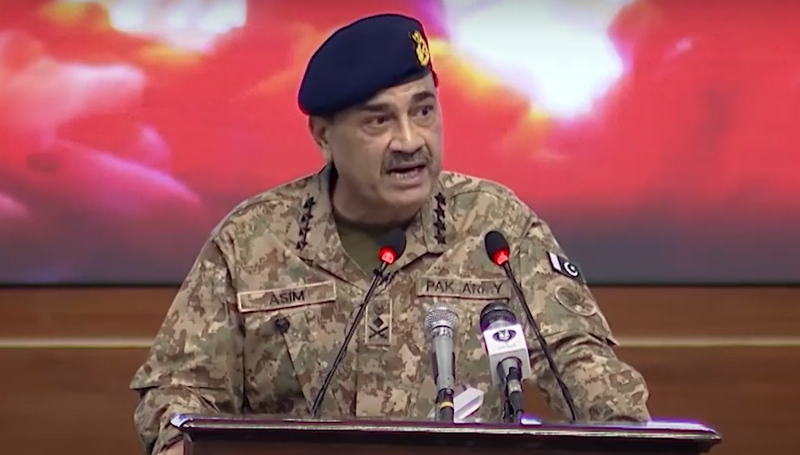
Pakistan's defence chief Asim Munir. Photo: Screen-grab from X

'Divine help saved us': Asim Munir credits faith after Pakistan’s May clash with India

| @indiablooms | Dec 22, 2025, at 05:30 pm

Islamabad/IBNS: Pakistan’s Chief of Defence Staff, Field Marshal Asim Munir, has claimed that Islamabad received “divine help” during its brief but intense military confrontation with India in May, following New Delhi’s Operation Sindoor strikes on terror infrastructure across the border.

 
Speaking at the National Ulema Conference in Islamabad earlier this month, Munir said Pakistan’s armed forces experienced what he described as “divine intervention” during the four-day escalation with India. 
 
Reciting verses from the Quran, the army chief framed the conflict in religious terms, telling the gathering that Pakistan’s military felt the presence of divine assistance.

“We felt it,” Munir said, referring to the May hostilities that followed India’s precision strikes.
 
Operation Sindoor and the May escalation
 
India launched Operation Sindoor on May 7 in response to the Pahalgam terror attack, which claimed the lives of 26 civilians. 
 
The operation targeted terror camps and infrastructure in Pakistan and Pakistan-occupied Kashmir, triggering days of cross-border military exchanges.

The confrontation marked one of the sharpest India-Pakistan escalations in recent years and ended on May 10 after both sides reached an understanding to halt military action.
 
Religious framing of Pakistan’s military role
 
During his address, Munir drew ideological parallels between Pakistan and the early Islamic state established more than 1,400 years ago in the Arabian Peninsula. 
 
He asserted that Pakistan holds a special position among Muslim-majority nations, claiming that the country had been divinely entrusted with a unique role in the Islamic world.

Munir said that out of 57 Islamic countries, Pakistan had been granted a special honour, referring to the protection of Haramain Sharifain—Makkah and Madina—though those sites are geographically located in Saudi Arabia. 
 
His remarks underscored the increasing religious tone in Pakistan’s military discourse.
 
Warning to Afghan Taliban over TTP

The Pakistan army chief also issued a blunt warning to Afghanistan’s Taliban government, urging it to choose between Islamabad and Tehrik-i-Taliban Pakistan (TTP), the militant group responsible for numerous attacks inside Pakistan.

Munir claimed that Afghan nationals make up a significant portion of militants infiltrating Pakistan from across the western border. 

According to him, nearly 70 percent of fighters entering Pakistan under the TTP banner are Afghans.

“Is Afghanistan not spilling the blood of our Pakistani children?” he asked, repeating his demand that the Taliban government distance itself from the TTP.
 
Authority over jihad claims
 
Addressing religious scholars, Munir asserted that the authority to declare jihad rests solely with the state in an Islamic system. 
 
He said no individual or group could issue a fatwa for jihad without the consent and direction of the state.

His statement appeared aimed at delegitimising non-state militant groups that justify violence using religious arguments, even as Pakistan continues to face persistent internal security challenges.
 
Politics, faith and regional tensions
 
Munir’s remarks come at a time of heightened regional sensitivity, with strained India-Pakistan relations and worsening ties between Islamabad and Kabul. 
 
By invoking divine intervention and issuing warnings to the Afghan Taliban, the Pakistan military chief blended faith, geopolitics and security narratives, reinforcing the ideological posture of Pakistan’s military establishment amid ongoing regional turbulence.

Support Our Journalism

We cannot do without you.. your contribution supports unbiased journalism

IBNS is not driven by any ism- not wokeism, not racism, not skewed secularism, not hyper right-wing or left liberal ideals, nor by any hardline religious beliefs or hyper nationalism. We want to serve you good old objective news, as they are. We do not judge or preach. We let people decide for themselves. We only try to present factual and well-sourced news.

Support objective journalism for a small contribution.