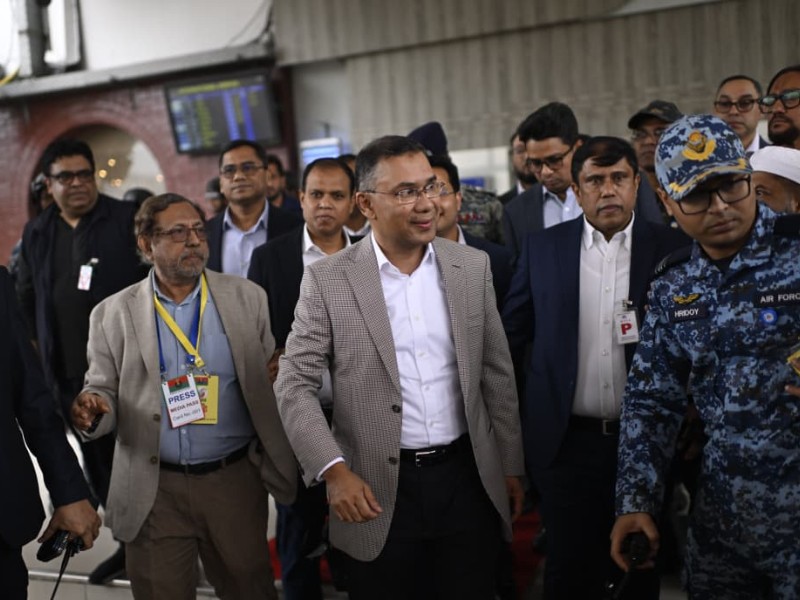
His arrival at Sylhet airport marked the end of a prolonged absence that began in 2008, when he left the country for medical treatment amid mounting legal cases and political pressure.
Rahman’s homecoming comes at a time when Bangladesh remains gripped by unrest following the ouster of former prime minister Sheikh Hasina and the installation of a Muhammad Yunus-led interim government.
With parliamentary elections scheduled for February 12, his return is widely viewed as a moment with far-reaching political implications.
A long exile ends amid political flux
Tarique Rahman, now 58, has spent nearly two decades directing BNP affairs from London, emerging as the party’s de facto leader despite his physical absence.
His return closes a chapter defined by exile, court battles and internal party uncertainty, and opens another at a moment when Bangladesh’s political order is being rewritten.
Rahman’s re-entry into domestic politics has been enabled by a series of legal developments over the past year.
Higher courts acquitted him in major cases, including the 2004 grenade attack and the Zia Orphanage Trust graft case, removing the principal legal barriers that had kept him abroad.
These verdicts cleared the way for his return just as the BNP positions itself for elections in an altered political arena.
Why the timing matters
Rahman’s arrival coincides with heightened instability across Bangladesh.
Since Sheikh Hasina’s removal after a mass uprising last year, the country has experienced repeated bouts of violence.
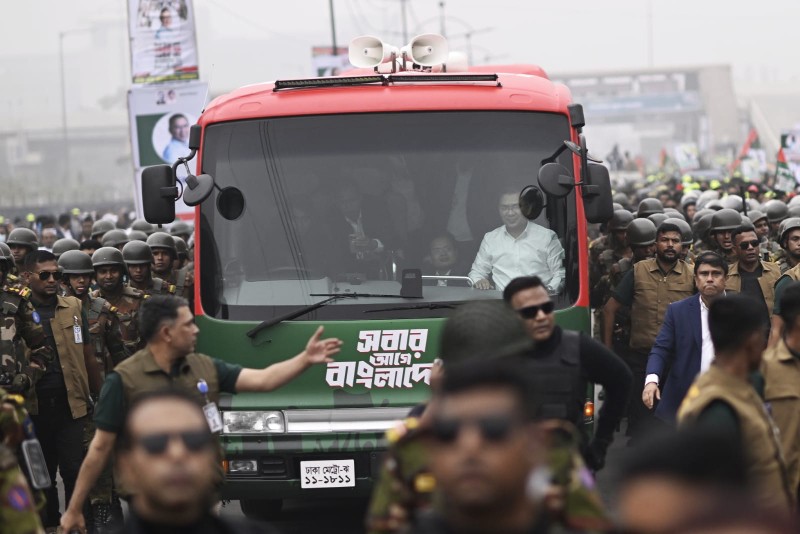 BNP's acting chairman and former Bangladesh PM Khaleda Zia's son Tarique Rahman returns home after 17 years in exile. Photo: Facebook/bnpbd.org
The recent killing of Osman Hadi, a youth leader who played a role in Hasina’s ouster, reignited tensions, with his family alleging the murder was intended to derail the electoral process.
Against this backdrop, Rahman’s return is not merely symbolic.
With Khaleda Zia, now 80, battling serious health issues and largely absent from active politics, the BNP has lacked a visible central figure on the ground. Rahman’s presence addresses that vacuum at a critical juncture.
Interim government’s role in Rahman’s return
The Yunus-led interim administration played a facilitative role in Rahman’s homecoming.
Earlier this month, Foreign Adviser Md Touhid Hossain publicly indicated that a “one-time” travel pass could be issued swiftly should Rahman decide to return.
Chief Adviser Muhammad Yunus also discussed the matter in official meetings, according to government sources.
This administrative green light underscores the interim government’s broader mandate to stabilise the country and oversee elections following years of political paralysis.
Yet it also places Rahman squarely at the centre of a transition period marked by uncertainty and competing claims of legitimacy.
Who is Tarique Rahman?
As the elder son of Khaleda Zia, Tarique Rahman has long been one of the most polarising figures in Bangladeshi politics.
Once convicted on charges ranging from money laundering to involvement in an alleged assassination plot against Sheikh Hasina, he has consistently denied wrongdoing, framing the cases as politically motivated.
Despite years away from the country, Rahman retained firm control over the BNP’s strategic direction.
Supporters portray him as the natural heir to the Zia political legacy, while critics view his return as reopening unresolved questions about accountability and governance.
Electoral stakes and BNP strategy
Rahman has openly stated his intention to contest the upcoming general elections, telling BBC Bangla that the time had come for his return and direct participation in politics.
BNP leaders say he will complete voter registration formalities on December 27, a procedural step that signals his readiness to enter the electoral fray.
With the Awami League barred from contesting elections by the interim government, the BNP sees a rare opportunity to reclaim power after years in opposition.
The collapse of traditional alliances, including the long-standing BNP–Jamaat partnership, and the emergence of new forces like the student-led National Citizen Party have further complicated the political equation.
Can Rahman emerge as prime minister?
Political observers increasingly view the BNP as a frontrunner in the upcoming polls, largely due to the absence of its long-time rival, the Awami League.
In that context, Rahman is being widely tipped as a potential prime ministerial candidate should the BNP secure a majority.
His return is seen by party insiders as an attempt to consolidate authority, restore organisational discipline, and project a single leadership face to voters.
Whether that strategy resonates with an electorate shaped by years of upheaval remains uncertain.
The shadow of Khaleda Zia’s legacy
Bangladesh’s modern political history has been dominated by the rivalry between Sheikh Hasina and Khaleda Zia.
Zia served two terms as prime minister between 1991 and 1996, and again from 2001 to 2006.
Her rule remains deeply divisive, remembered both for democratic transitions and for allegations of corruption, minority persecution and governance failures.
Tarique Rahman’s political identity is inseparable from that legacy.
His return inevitably revives debates about the Zia family’s past role in power and its relevance to Bangladesh’s future.
A carefully choreographed return
According to BNP leaders, Rahman’s initial schedule reflects an effort to link his comeback with key moments of party history and recent unrest.
He is set to address supporters, visit his ailing mother, pay respects at the graves of BNP founder Ziaur Rahman and slain youth leader Osman Hadi, and meet victims of last year’s mass uprising.
Each stop underscores the political symbolism of his return, blending family legacy, party loyalty and recent upheavals into a single narrative.
As Bangladesh approaches one of its most consequential elections in decades, Tarique Rahman’s return after 17 years of exile has injected fresh momentum—and fresh uncertainty—into an already fragile political landscape.



 Bangladesh