UN agency urges focus on rural development to 'break the chain of desperation'
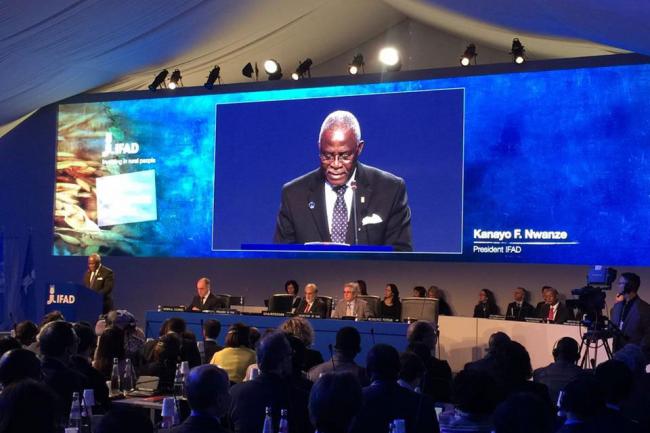
“By working together to deliver on the Sustainable Development Goals (SDGs) – starting with zero poverty and zero hunger – we can break the chain of desperation” that leads to emergencies and humanitarian disaster,” said Kanayo F. Nwanze, President of the UN International Fund for Agricultural Development (IFAD), on the final day of the agency's Governing Council.
The two-day conference, which is held annually in Rome for officials representing IFAD's 176 member states, heard urgent calls for action in support of increased investment in smallholder agriculture to ensure food security, climate change adaptation, equitable prosperity and, ultimately, to remove the root causes that lead to conflict and migration.
Delivering this year's lecture, Mohamed Ibrahim, an entrepreneur and founder of the Mo Ibrahim Foundation, took African governments to task for not living up to their commitments to invest in agriculture and rural development.
Stressing that it is essential that African governments create opportunities for young people in agriculture so that they are able to resist the “dangerous call of extremism,” Ibrahim noted that there are greater numbers of hungry, malnourished people in Africa than anywhere else in the world.
“No jobs, no hope,” he said. “We are by far the least productive region in the agriculture sector but because we have more uncultivated, arable land than anywhere else, it presents opportunities.”
Among the outcomes from the Farmers' Forum, a two-day meeting held in conjunction with IFAD's Governing Council, organizers announced a plan to make the platform more inclusive, inviting pastoralists and livestock breeders to take part in creating stronger links to smallholders and family farmers on the ground.
IFAD, based in Rome, is both a UN agency and an international financial institution. Since 1978, it has invested about $17.6 billion in grants and low-interest loans to developing countries through projects that have reached about 459 million people.
Photo: IFAD
Support Our Journalism
We cannot do without you.. your contribution supports unbiased journalism
IBNS is not driven by any ism- not wokeism, not racism, not skewed secularism, not hyper right-wing or left liberal ideals, nor by any hardline religious beliefs or hyper nationalism. We want to serve you good old objective news, as they are. We do not judge or preach. We let people decide for themselves. We only try to present factual and well-sourced news.
Support objective journalism for a small contribution.