 US-Iran
US unleashes sea drones on Iran for first time as Trump announces 20 percent Hormuz cargo charge
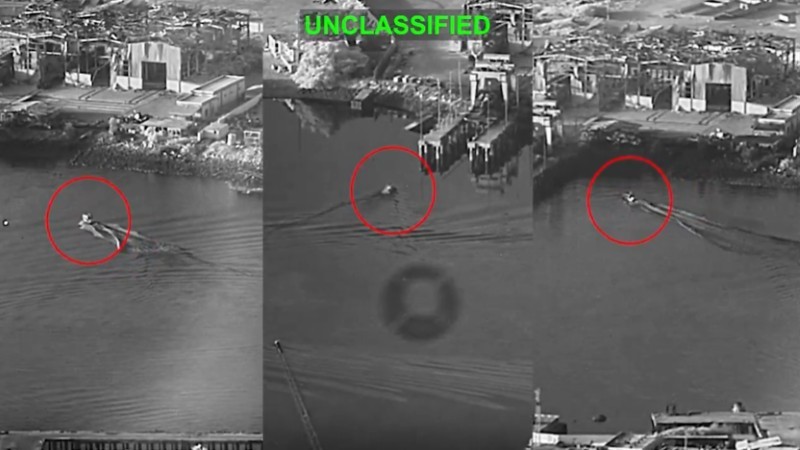
A video released by the US Central Command (CENTCOM) showed American forces using multiple one-way attack surface drones to strike a submarine and ship maintenance facility in Iran.
CENTCOM said the operation marked the first time US forces had used sea drones in combat.
Sharing details of the attack, CENTCOM wrote on X: “Yesterday, using multiple one-way attack surface drones, CENTCOM forces successfully struck a submarine and ship maintenance facility in Iran.”
— U.S. Central Command (@CENTCOM) July 14, 2026
“Three Corsair unmanned surface vessels hit the port at Bandar Abbas Naval Base, marking the first time American forces have employed sea drones in combat operations. Last night’s strikes degraded Iran’s ability to continue attacking commercial shipping,” the post said.
In a separate statement, CENTCOM said it completed its latest wave of strikes against Iran on July 13.
During the five-hour mission, US forces struck military targets across Iran, including Bushehr, Chabahar, Jask, Konarak, Abu Musa and Bandar Abbas, in an effort to further degrade Tehran's ability to attack commercial shipping, CENTCOM said.
According to the command, more than 50,000 US service members are currently deployed across the Middle East.
Yesterday, using multiple one-way attack surface drones, CENTCOM forces successfully struck a submarine and ship maintenance facility in Iran. Three Corsair unmanned surface vessels hit the port at Bandar Abbas Naval Base, marking the first time American forces have employed sea… pic.twitter.com/bOM2kmgRxz
— U.S. Central Command (@CENTCOM) July 13, 2026
The United States and Iran have traded attacks in recent days, further escalating tensions in the Middle East.
Trump announces 20 per cent charge on cargo passing through Strait of Hormuz
Meanwhile, US President Donald Trump announced that Washington would charge “20 per cent on all cargo shipped” through the Strait of Hormuz.
“The Hormuz Strait is OPEN, and will remain OPEN, with or without Iran. We are reinstating the IRANIAN BLOCKADE, so named because it is only stopping Iran’s ships or customers from entering or leaving. All other countries will have fair and open use of the Strait,” Trump wrote on Truth Social.
Also Read: Trump announces 20% fee on cargo through Hormuz, declares US 'guardian' of strategic waterway
“The U.S.A. will be, from this point forward, known as ‘THE GUARDIAN OF THE HORMUZ STRAIT,’ but as such, and as a matter of FAIRNESS, will be reimbursed, at the rate of 20% on all cargo shipped, for any and all costs necessary to do the job of providing safety and security to this very volatile section of the World,” he added.
Why is the Strait of Hormuz crucial?
The Strait of Hormuz is one of the world's most important energy chokepoints, with around one-fifth of global oil and liquefied natural gas supplies typically passing through the strategic waterway.
Meanwhile, UN agencies on Monday called for de-escalation amid the recent surge in strikes linked to the US-Iran conflict.
Following the UN Secretary-General's call on Sunday for further negotiations between the United States and Iran, the Council of the International Maritime Organization (IMO) condemned the latest attacks on civilian vessels in the strait and called for swift de-escalation.
Also Read: Republican Senator and top Trump ally Lindsey Graham dies at 71 after sudden illness
The council stressed in a separate resolution that the right of transit passage through straits used for international navigation should not be threatened, impeded, denied, hampered, impaired or suspended.
The IMO also reiterated that any measures taken by coastal states to regulate traffic in vital shipping lanes should be in accordance with its regulations under the International Convention for the Safety of Life at Sea.
Right of passage
Addressing the ongoing challenges facing international shipping in and around the Strait of Hormuz, the council stressed that any arrangement between the littoral states of the region should guarantee the non-discriminatory and unimpeded right of transit passage for all ships through the internationally recognised traffic separation scheme adopted by the IMO in 1968.
In a social media post on Monday, Trump insisted that the strait would “remain open” and said Washington would reinstate its blockade of Iranian ports.
Proposed toll draws attention
Trump also said the United States would begin charging a 20 per cent fee on goods passing through the waterway, arguing that the charge was necessary to cover the cost of providing “safety and security”.
The IMO council, however, reaffirmed in an earlier statement that passage through the Strait of Hormuz should remain free of tolls and charges in accordance with international law, including the IMO Convention adopted in 1948.
It also requested the Secretary-General to explore options to advance safe maritime traffic and work with littoral states, other member states and the shipping industry to ensure a coordinated and sustainable return to unhindered passage.
Global economic impact
Humanitarian and economic shocks have been felt for months in the Strait of Hormuz, according to a July 10 report by Switzerland-based ACAPS, an independent organisation specialising in humanitarian needs analysis and assessment.
The near-continuous closure of the strait since February has triggered a significant global commodity price shock, according to the World Bank.
Global energy prices rose by 24 per cent following the onset of the conflict, while fertiliser prices were projected in April to increase by more than 30 per cent in 2026, the World Bank said.
Support Our Journalism
We cannot do without you.. your contribution supports unbiased journalism
IBNS is not driven by any ism- not wokeism, not racism, not skewed secularism, not hyper right-wing or left liberal ideals, nor by any hardline religious beliefs or hyper nationalism. We want to serve you good old objective news, as they are. We do not judge or preach. We let people decide for themselves. We only try to present factual and well-sourced news.
Support objective journalism for a small contribution.