 Turkey-Syria Earthquake
WFP chief describes ‘apocalyptic’ post-quake landscape in Syria, Türkey
New York: The head of the UN World Food Programme (WFP) concluded a visit on Saturday to devastated Syrian and Turkish communities and aid supply routes, calling on authorities to open more border crossings to help survivors of the earthquakes that hit both countries in early February.
“While the world has quickly mobilized in support of people here, the impact of this quake will be felt for months and years to come,” said WFP Executive Director David Beasley.
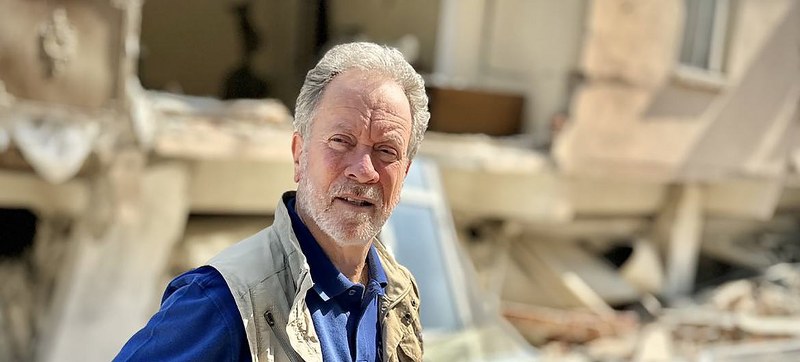
During a visit to the Hatay region in southern Türkey, he described “incomprehensible” devastation and an “apocalyptic” landscape.
With some 18 million people affected across southern Türkey and northwest Syria, tens of thousands of lives have been lost, and millions upon millions of people have lost their homes, livelihoods, and assets, he said.
‘Apocalyptic’ conditions
Visiting several affected communities, he said that Antakya, which suffered significant deaths and massive destruction, is now “almost a ghost town”, with homes, schools, shops and critical infrastructure damaged and destroyed.
“There is only one way to describe what I saw today: apocalyptic,” he said. “Entire neighborhoods have been flattened, homes destroyed, schools and shops closed, lives torn apart. The scale of devastation here is truly incomprehensible.”
At the Boynuyoğun refugee camp, Mr. Beasley met with families whose homes were reduced to rubble. The camp is one of seven where WFP has been supporting Syrian refugees for years.
Now, assistance is being scaled up to include Turkish families displaced by the earthquake, WFP said.
On the Syrian side, Mr. Beasley described the situation as a “catastrophe on top of a catastrophe”. The earthquake followed 12 years of unrelenting conflict, and the areas hardest hit lack the capacity and infrastructure to deal with the impact of a disaster of this magnitude.
Open more borders
At the UN transport hub, the WFP chief saw trucks being loaded with food and other emergency items. Drivers will bring the life-saving supplies to the Bab al-Hawa border crossing en route to non-government-controlled areas of northwest Syria.
“Our trucks are rolling, and this food and other supplies will literally save thousands and thousands of lives,” said Mr. Beasley, as he watched a 21-truck convoy carrying 380 tonnes of food into Syria.
Since the border crossing re-opened on 13 February, WFP has supported the crossing of 180 trucks into northwest Syria.
While welcoming the recent re-opening of vital supply routes, he underlined the need to resume and scale up crossline deliveries. In this regard, he called on all parties to further facilitate access.
“Food assistance must get to the people of northwest Syria from all sides, through all routes, without any restrictions,” he said.
2.3 million reached
In the wake of the earthquakes, WFP has rapidly mobilized, reaching more than 2.3 million affected people across both countries.
Meanwhile, WFP funding requirements for the emergency response in Türkiye stands at $80 million to swiftly ramp up assistance through food and cash and $150 million is needed to support for six months 800,000 people affected in Syria.
Another $300 million is required to maintain WFP’s food assistance programme across all of Syria for 5.5 million people every month. If this is not received, the UN food programme will be forced to suspend its assistance to 3.8 million Syrians within months, WFP said.
Support Our Journalism
We cannot do without you.. your contribution supports unbiased journalism
IBNS is not driven by any ism- not wokeism, not racism, not skewed secularism, not hyper right-wing or left liberal ideals, nor by any hardline religious beliefs or hyper nationalism. We want to serve you good old objective news, as they are. We do not judge or preach. We let people decide for themselves. We only try to present factual and well-sourced news.
Support objective journalism for a small contribution.