Between Gandhi and Mussolini: A Search for Meaning in a Fractured World
A chance juxtaposition of Gandhi and Mussolini in a Kolkata bookshop sparks a reflection on coexistence, responsibility, and the enduring search for meaning in a fractured world, writes veteran journalist and poet Pritha Lahiri
When peace is at a premium and war is at its peak, when the face of terror and violence stares unblinkingly into our eyes, when sane and saner voices are drowned out amidst devastating conflicts, the serene, smiling face of someone long departed beckons us with hope.
Maybe all is not lost. If the world could overcome fascism—at least in part—if the persecuted could rise to prosecute, a sliver of hope remains that all is not yet lost, even as democracy recedes and autocracy gains ground.
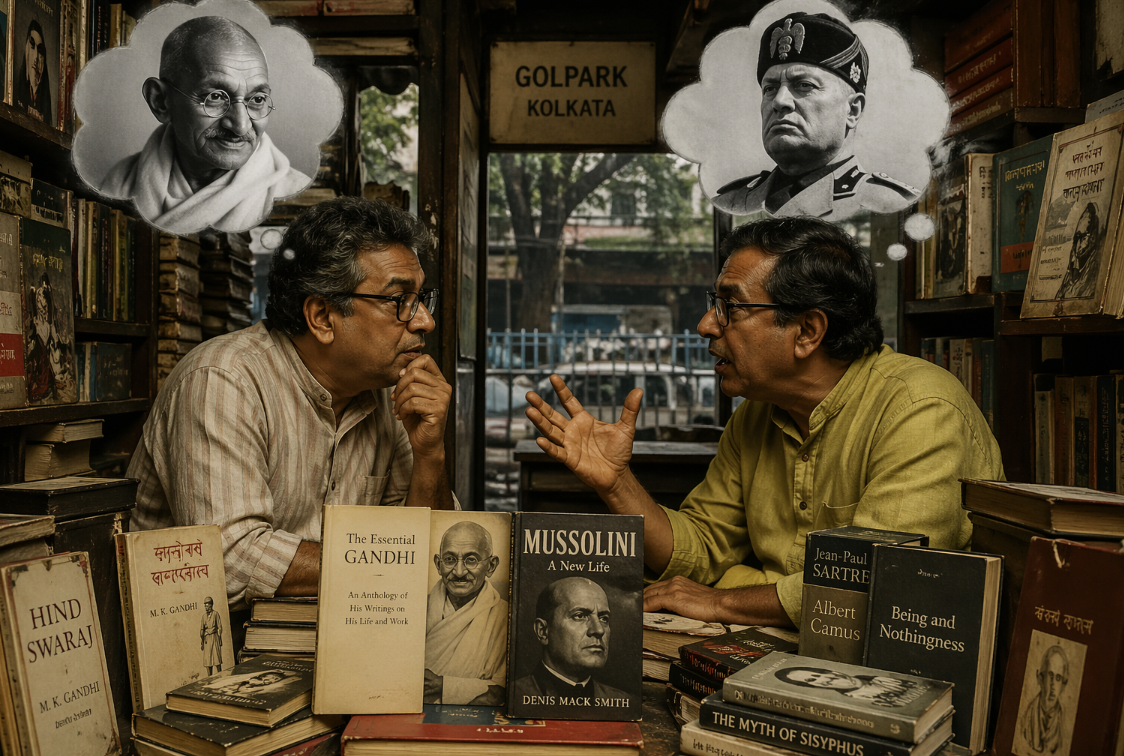
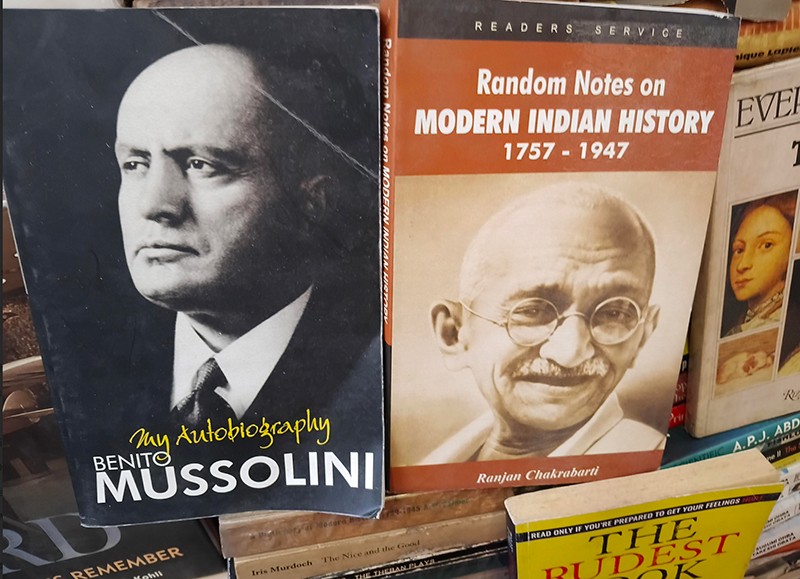
Two men of vastly differing ideologies share space on a wayside rack in a bookshop in Golpark, Kolkata. The congruity—or incongruity—of their textual bonhomie may well be food for thought in a world deprived of harmony. Yet this very coexistence raises the expectation that disparate beings and ideas can still find common ground in a world riven by egoism, greed and brutality.
The bedrock of Mohandas Karamchand Gandhi’s philosophy was truth and non-violence, emphasising self-transformation, the pursuit of justice through peaceful resistance, self-reliance, and service to others. Benito Mussolini’s doctrine, known as Fascism, relied on a totalitarian, anti-democratic, and violently nationalistic dogma where the state was supreme.
Gandhi, who met Mussolini in Rome in 1931, had praised his social reforms for the poor. Yet he remained critical of the dictator’s ideology, reflecting his commitment to plain speaking and truth.
When engaging with the philosophies of these two men, who left indelible marks on history, another doctrine comes to mind—existentialism.
Proponents of existentialism, a 20th-century philosophical movement, emphasised individual freedom, responsibility and subjectivity. It holds that we are each responsible for creating purpose and meaning in our lives—and fully accountable for our actions. One of its key concepts is absurdity: the idea that the universe lacks inherent meaning or rationality, leading to a condition where humans search for meaning in a fundamentally indifferent world.
If that be so, our search for meaning will remain elusive if we eschew the path of responsibility.
It must also be noted that individual freedom comes with responsibility. Liberalism is the pivot for individual freedom and growth, but inherent within it are both rights and duties. Only then can a society truly thrive and prosper.
We can only hope that our search for meaning in a seemingly meaningless world—hamstrung by wars and violence—ends on a positive note, where we are able to transform ourselves in pursuit of justice through peaceful resistance. A world where self-reliance and service to others take precedence over self-service and self-aggrandisement.
I will end with a quote by Gandhi: "When I despair, I remember that all through history the way of truth and love have always won. There have been tyrants and murderers, and for a time, they can seem invincible, but in the end, they always fall. Think of it -- always."
Support Our Journalism
We cannot do without you.. your contribution supports unbiased journalism
IBNS is not driven by any ism- not wokeism, not racism, not skewed secularism, not hyper right-wing or left liberal ideals, nor by any hardline religious beliefs or hyper nationalism. We want to serve you good old objective news, as they are. We do not judge or preach. We let people decide for themselves. We only try to present factual and well-sourced news.
Support objective journalism for a small contribution.