'How can anything foreign be in a jugular vein?' India slams Pak army chief's Kashmir remark
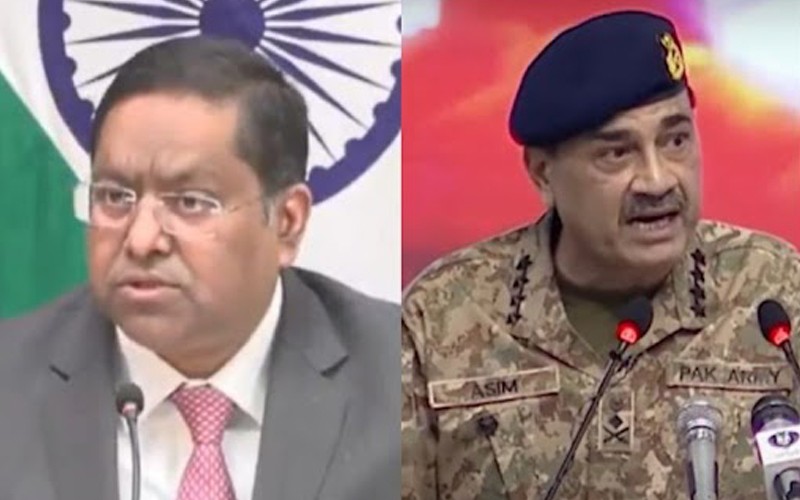
New Delhi/IBNS: India has rubbished Pakistani army chief General Asim Munir's remarks in which the latter claimed that Kashmir was Islamabad's "jugular vein".
In a strongly worded statement, the Ministry of External Affairs (MEA) told reporters that Pakistan's "only relationship with Kashmir" is to vacate the illegally occupied territory.
"How can anything foreign be in a jugular vein? This is a Union Territory of India. Its only relationship with Pakistan is the vacating of illegally occupied territories by that country," MEA spokesperson Randhir Jaiswal said.
This comes after General Munir has backed the "two-nation theory," stating that Pakistani forefathers who favoured the bifurcation of India in 1947 had realised the distinction between Hindus and Muslims, media reports said.
Addressing the Overseas Pakistanis Convention in Islamabad, he said: "Our forefathers believed that we were different from Hindus in every possible aspect of life. Our religion is different. Our customs are different. Our traditions are different. Our thoughts are different. Our ambitions are different... That was the foundation of the two-nation theory. It was laid on the belief that we are two nations, not one."
"You must tell this to your children so that they never forget the story of Pakistan," he said and added, "Our forefathers made immense sacrifices, and we too, have sacrificed a lot for the creation of this country... My dear brothers and sisters, and sons and daughters, please do not forget this story."
Pakistan's founder, Muhammad Ali Jinnah, and the All India Muslim League had favoured the two-nation theory in the 1930s and 1940s, believing that Muslims couldn't live freely in Hindu-majority India after the British left.
In 1930, philosopher-poet Allama Iqbal had proposed the idea of creating a separate Muslim state in North-West India.
In 1940, the Lahore Resolution had even demanded "independent states" for Muslims in East and North-West India.
When British rule ended in 1947, India was divided into two nations- secular, Hindu-majority India and Muslim-majority Pakistan.
Support Our Journalism
We cannot do without you.. your contribution supports unbiased journalism
IBNS is not driven by any ism- not wokeism, not racism, not skewed secularism, not hyper right-wing or left liberal ideals, nor by any hardline religious beliefs or hyper nationalism. We want to serve you good old objective news, as they are. We do not judge or preach. We let people decide for themselves. We only try to present factual and well-sourced news.
Support objective journalism for a small contribution.