 Rahul Gandhi
Rahul Gandhi’s ‘Smash Patriarchy’ push faces backlash over Manusmriti, hijab and women’s rights
Rahul Gandhi’s attempt to make women’s autonomy the centrepiece of his latest youth outreach has quickly turned into a wider political argument over Manusmriti, patriarchy, religious practices and the Congress leader’s approach to women’s rights.
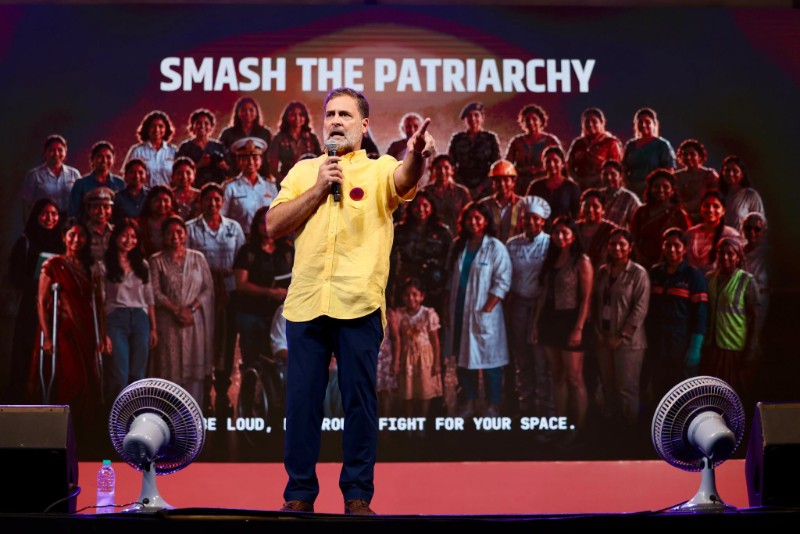
Speaking at the fourth edition of his ‘Chhatron Ki Goonj’ programme in Pune on Saturday (August 22), the Leader of Opposition in the Lok Sabha told young women that their identities should not be defined only by their relationships with men.
He criticised what he described as a patriarchal mindset and invoked a passage from the Manusmriti to argue that women should not be treated as dependent on fathers, husbands or sons.
“You do not belong to anybody, except yourself,” Rahul Gandhi said.
He also urged women to “smash the patriarchy” and told them to “be loud, be proud, fight for your space in society”.
The remarks drew an immediate political response from the BJP and the Vishva Hindu Parishad (VHP), while social media discussions focused on whether Gandhi was applying his argument consistently across religious and social contexts.
Among the claims circulating online was criticism over the presence of a woman wearing a hijab on or around the stage during the event.
The footage and reports establish that women participated in Gandhi’s interaction, including women who spoke about social restrictions and pressures they had faced.
However, the broader claims made on social media about what the presence of a hijab-wearing participant proves remain matters of political interpretation rather than established evidence of Gandhi’s position on that individual’s choice of clothing.
Gandhi’s Manusmriti argument in Pune
Gandhi began his address by arguing that Indian society often reduces women to three identities — daughter, wife and mother.
“Whenever I speak to a man,” Gandhi said, “women are put in three boxes: you are either seen as a daughter, as a wife or as a mother.”
He acknowledged that these relationships were important but argued that they should not constitute a woman’s only identity.
“This cannot be your only identity,” he said, pointing to women working as professionals, sportswomen and in other fields.
Gandhi then referred to a passage from the Manusmriti concerning the position of women within family structures.
He described the prescription as a “shame” and rejected the idea that women should be subject to male relatives at different stages of their lives.
The Congress leader argued that a woman's identity and autonomy should not depend on her relationship with a father, husband or son.
“Because these words should never, ever have been spoken,” Gandhi said. “You do not belong to anybody, except yourself.”
His remarks placed Manusmriti at the centre of an argument about contemporary gender relations, rather than treating the text only as a historical subject.
‘Smash the patriarchy’ becomes central message
The Pune programme was primarily aimed at women and girl students, with several participants discussing personal experiences involving education, employment, harassment, public safety and social expectations.
One participant spoke about the difficulties she faced while pursuing a career and continuing her studies.
Others discussed sexual harassment, concerns about safety on public transport and pressure to marry despite wanting to continue their education.
Bhojpuri singer Neha Rathore also participated in the programme and spoke about online trolling and attacks on women's character.
Rathore, who has criticised the BJP government and has faced action by Uttar Pradesh Police, discussed the scrutiny she encountered after making political videos.
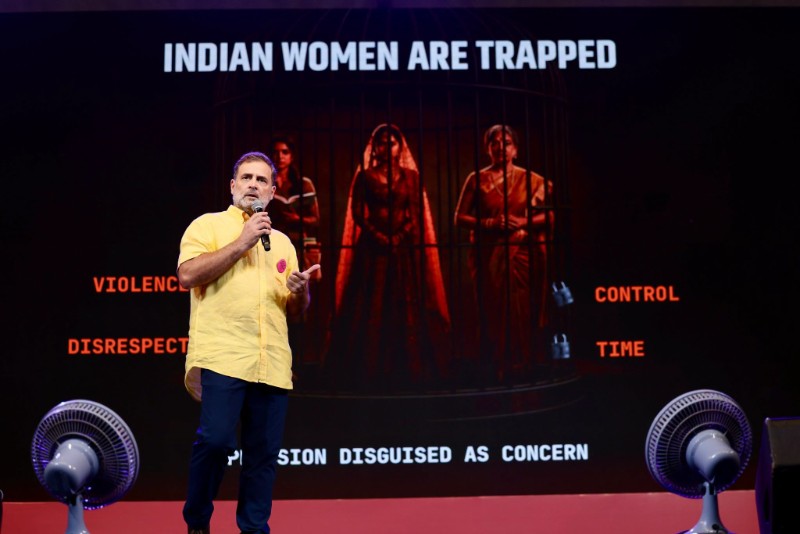 Photo: Facebook/@rahulgandhi
Gandhi used these accounts to frame his broader argument about women's independence.
His message was not limited to employment or education.
He presented autonomy as involving the freedom to make personal decisions without being constrained by gender-based expectations.
“Be loud, be proud, fight for your space in society,” he told the women.
Gandhi attacks ‘double standards’ over women protesters
The Congress leader also criticised Prime Minister Narendra Modi over his reaction to women protesters using abusive language during recent demonstrations at Jantar Mantar.
Gandhi played an excerpt from Modi's remarks in which the Prime Minister expressed surprise at women protesters using expletives, including against him and his mother.
He contrasted those remarks with earlier statements by Modi and other public figures.
“If boys use expletives, then no problem, they are allowed to do it. But if girls use expletives, it is a cultural shock; it does not befit them,” Gandhi said.
He also referred to earlier remarks by RSS chief Mohan Bhagwat and Union minister Manohar Lal Khattar on sexual violence and women's behaviour.
Gandhi argued that such comments reflected what he described as a wider mindset in which women are expected to remain within prescribed social boundaries while men enjoy greater freedom.
“This mindset is that a girl has a place [to be put in], that she should be closed in a cage, she should be controlled, she should not work, and boys should have full freedom,” he said. “We don’t want this kind of India.”
The remarks added a contemporary political dimension to the Manusmriti reference and allowed Gandhi to link the historical text with what he described as continuing patriarchal attitudes.
VHP attacks Gandhi over Manusmriti reference
The Vishva Hindu Parishad criticised Gandhi's remarks on Sunday.
VHP national spokesperson Vinod Bansal accused Gandhi of selectively quoting the Manusmriti and argued that the Congress leader should read the text in its entirety before drawing conclusions about Hindu society.
“Rahul Gandhi ji, it is very easy for you to pick a single shloka from the Manusmriti without understanding it and put the Hindu society in the dock,” Bansal said in a post on X.
“Do not poison the pure minds of the country’s youth with your impure mindset,” he added.
Bansal also challenged Gandhi to publicly discuss passages concerning women in the Quran, the Bible and other religious texts, arguing that selective quotations and interpretations could distort political debate.
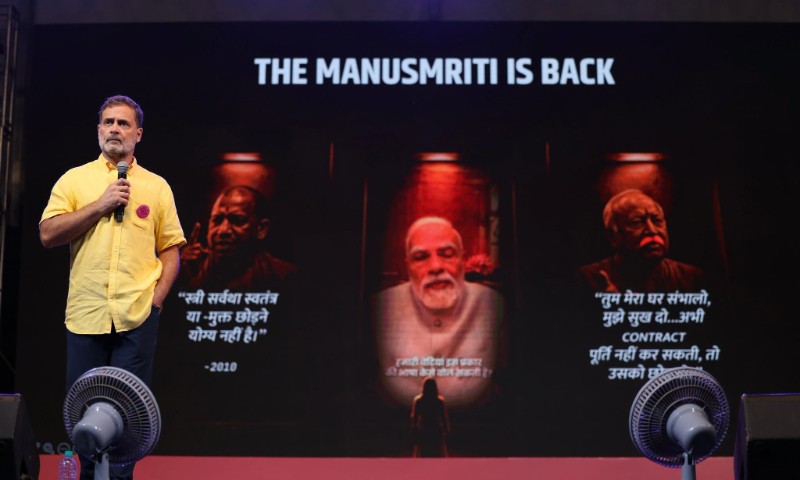 Photo: Facebook/@rahulgandhi
The VHP spokesperson further argued that the debate should not reduce Hindu society or its cultural history to a single text or passage.
The criticism reflects a broader dispute over whether Gandhi's reference to Manusmriti represents a legitimate criticism of patriarchal ideas or a selective political interpretation of Hindu scripture.
BJP calls Pune event a ‘political comedy show’
The BJP also targeted Gandhi's programme, describing it as a political exercise rather than a genuine student interaction.
BJP Maharashtra vice-president Keshav Upadhye called the event a “political comedy show” and alleged that Gandhi had offered general political rhetoric rather than addressing the substantive concerns of students.
The BJP also questioned the mobilisation of attendees and alleged that college buses were used to bring people to the programme.
“Rahul Gandhi's Pune event was yet another political comedy show,” Upadhye said. “While searching for Manuwad, the Congress should first look in the mirror.”
The Maharashtra BJP had also raised questions about the funding of the event before it was held.
BJP spokesperson Navnath Ban alleged that students or influencers were being offered money to attend or promote the programme.
The Congress rejected the allegations and said the event had received a large response from young people.
Fadnavis joins attack
Maharashtra Chief Minister Devendra Fadnavis joined the BJP's criticism by questioning Gandhi's position on the Women's Reservation Bill.
Fadnavis argued that Gandhi could not speak about women's empowerment in Pune while, according to the BJP's account, opposing legislation intended to increase women's representation in Parliament.
“Coming to Pune to talk about women and then opposing the very bill that would give them real power, that's Rahul Gandhi's hypocritical stand,” Fadnavis said.
He further alleged that Gandhi's public statements on women's empowerment did not match his political actions and described the Congress as a “directionless party of show-offs and loudmouths”.
The Congress rejected the criticism.
Party leader Sachin Sawant said the BJP was concerned about Gandhi's outreach to young people and accused the ruling establishment of attempting to obstruct the programme.
The exchange turned the Pune event into another episode of the broader BJP-Congress contest over youth politics and women's representation.
Yogi Adityanath hits out at RaGa
Uttar Pradesh Chief Minister Yogi Adityanath on Monday criticised Rahul Gandhi over his remarks on the Manusmriti, accusing the Congress leader of treating it as his “birthright” to denigrate India’s traditions and cultural heritage.
Speaking at an event in Raebareli, Yogi said there were few expectations from Gandhi and questioned his conduct as Leader of the Opposition in Parliament.
“Rahul Gandhi made a statement in Maharashtra urging women to break free from the shackles of the Manusmriti. Rahul ji, the country does not have high expectations of you merely as Rahul Gandhi; in fact, it has no expectations at all,” he said.
Yogi said Gandhi's constitutional position carried responsibilities towards the country and its democratic institutions.
“However, your role as the Leader of the Opposition in Parliament entails accountability towards the country’s democracy. You took an oath to uphold the Constitution of India, yet you seem to consider it your birthright to disparage India’s traditions and heritage,” the chief minister said.
Yogi also targeted Gandhi over his remarks concerning Manu, Lord Ram and India’s cultural legacy.
“When you travel outside Uttar Pradesh, you malign and insult the state; when you go abroad, you insult India itself. In the nation’s fight against terrorism, you directly or indirectly encourage anti-national elements. Your party questions the very existence of Lord Shri Ram in Ayodhya,” he alleged.
Referring to the Emergency imposed in 1975, Yogi also questioned Gandhi’s commitment to democracy.
“As for your commitment to democracy, the country witnessed the dark shadow of the Emergency in 1975,” he said.
Responding to Gandhi’s remarks on Manu and India’s heritage, Yogi advised the Congress leader to study ancient Hindu texts.
“You make comments regarding Manu, Ram, or India’s heritage. If you wish to understand Manu, read the Atharvaveda, the Shatapatha Brahmana and the Matsya Purana; you will find all the information there,” he added.
Shehzad Poonawalla reacts
Former BJP spokesperson Shehzad Poonawalla also targeted Rahul Gandhi for his call to “smash the patriarchy”.
Poonawalla, who recently resigned from the BJP, accused Gandhi of endorsing “misogyny, sexism and patriarchy”.
Taking a sharp dig at Gandhi, Poonawalla alleged that the Congress leader had himself made remarks that were inconsistent with his criticism of sexism.
“You pretty much endorsed misogyny, sexism and patriarchy when you and Sandeep Dikshit made that crass comment on Meloni. So cut the crap,” Poonawalla said.
Social media turns to the hijab question
Alongside the political attacks over Manusmriti, a separate argument emerged across social media concerning the presence of a woman wearing a hijab during the programme.
Some posts and commentators questioned why Gandhi was criticising patriarchal restrictions while a hijab-wearing woman was visible in footage from the event.
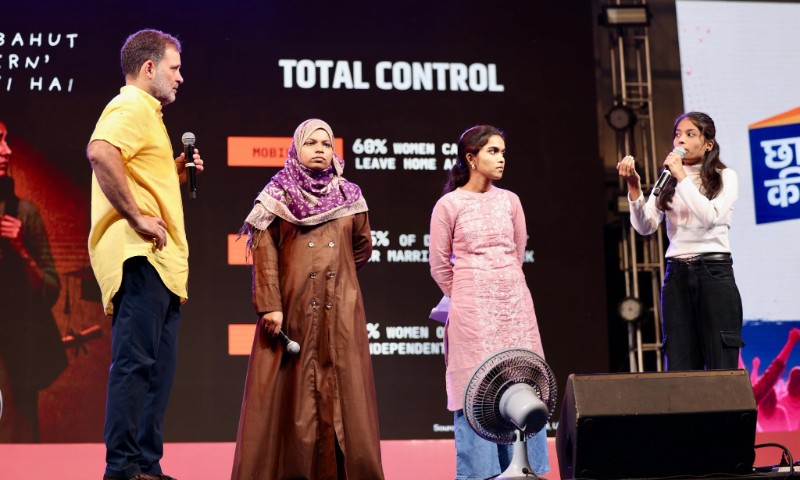 Photo: Facebook/@rahulgandhi
Others used the image to accuse him of applying different standards to different religious communities.
An OpIndia report focused specifically on a woman participant who spoke about restrictions she experienced while pursuing a cyber-security course.
According to the report, she said her family allowed her to leave home only after wearing a headscarf.
That account is significant because it adds a more complicated dimension to the online debate: the woman was reportedly discussing restrictions on her own choices and education rather than appearing at the event simply as a passive participant.
At the same time, social media users have interpreted the presence of hijab-wearing women at the programme as evidence of what they describe as inconsistency in Gandhi's women's-rights messaging.
Discussions on Reddit and other platforms have included claims that Gandhi should also address questions surrounding religious practices and women's autonomy outside the Hindu context.
Those reactions represent political and social-media commentary rather than established evidence that Gandhi endorsed or rejected the personal clothing choices of individual participants at the Pune event.
‘Manusmriti’ remark becomes part of online backlash
Another strand of the online reaction questioned the relevance of Manusmriti to contemporary political discussions, with users arguing that the text has little direct influence on the lives of most Indians today.
Others countered that Gandhi's reference was specifically about the persistence of social attitudes associated with patriarchal ideas, rather than a claim that Manusmriti itself governs modern India.
The BJP has sought to turn the reference into a wider argument about selective political targeting of Hindu traditions.
BJP leader Amit Malviya argued that India is governed by the Constitution rather than Manusmriti and accused Gandhi of selectively invoking the ancient text.
He also cited Mahatma Gandhi's historical views on Manusmriti, including Gandhi's position that the text contained both admirable and problematic elements.
The dispute has consequently shifted from the specific passage cited by Rahul Gandhi to a larger argument about the role of historical religious texts in contemporary political discourse.
Congress says focus is women’s autonomy
For Congress, the Pune event was part of a continuing youth outreach campaign that began in June and has featured interactions with students and young people.
The party has presented ‘Chhatron Ki Goonj’ as a platform where young people can speak about education, employment, competitive examinations and other concerns.
The Pune edition placed women and girls at the centre of the discussion.
The Congress has also sought to frame Gandhi's remarks as a discussion about women's independence rather than an attack on Hindu society.
Women’s outreach event becomes a wider political contest
Gandhi's Pune programme was designed to put women's experiences and autonomy at the centre of his youth outreach.
His references to Manusmriti, patriarchy, women's identity and the behaviour expected of female protesters gave the event a clear political and ideological dimension.
The subsequent backlash has broadened the discussion.
The BJP has questioned Gandhi's record on women's representation and accused him of political selectivity; the VHP has challenged his interpretation of Manusmriti, and Social media users have raised questions about religious practices, including the presence of hijab-wearing participants and whether Gandhi applies his argument about women's autonomy consistently across communities.
At the same time, the accounts of women who spoke at the event show that the programme also dealt with practical concerns around education, employment, safety, harassment and social pressure.
The competing narratives have ensured that what began as Gandhi's women-focused ‘Chhatron Ki Goonj’ outreach in Pune has quickly become a broader political debate over Manusmriti, patriarchy, religious practices, women's autonomy and the competing claims of the BJP and Congress on gender equality.
Support Our Journalism
We cannot do without you.. your contribution supports unbiased journalism
IBNS is not driven by any ism- not wokeism, not racism, not skewed secularism, not hyper right-wing or left liberal ideals, nor by any hardline religious beliefs or hyper nationalism. We want to serve you good old objective news, as they are. We do not judge or preach. We let people decide for themselves. We only try to present factual and well-sourced news.
Support objective journalism for a small contribution.